About Apodemus flavicollis (Melchior, 1834)
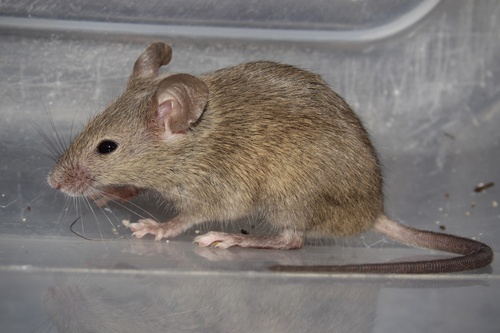
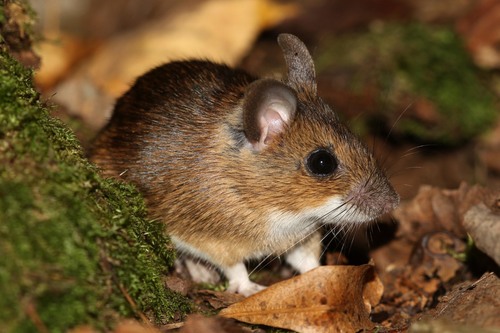
The yellow-necked mouse (scientific name Apodemus flavicollis (Melchior, 1834)) is very similar to the wood mouse, but can be distinguished by its slightly longer tail, larger ears, and a complete band of yellow fur across the neck area. Adult yellow-necked mice have a head and body length of 3.5 to 5.25 inches (89–133 mm), with a tail about the same length as the head and body. Their weight ranges between 1 and 1.5 ounces (28–43 g). Their upperparts are brownish-grey, a slightly browner shade than the wood mouse's upperparts. Their underparts are white, with a clear sharp boundary between the upperpart and underpart colouration. The species gets its common name from the ochre-coloured patch of fur between its forelegs, though this patch is often not easy to see. Juvenile yellow-necked mice have a paler greyish-brown upperpart colour than adult individuals. This species is native to Europe and western Asia. In Europe, its range covers most mountainous areas of Western Europe, excluding northern Scandinavia, southern Spain, and western France. It is present in Great Britain but absent from Ireland, and is also not found on a number of Mediterranean islands. In Asia, its range extends east as far as the Ural Mountains, and it can also be found in Turkey, Armenia, Iran, Syria, Lebanon and Israel. The yellow-necked mouse is primarily a woodland species, and often lives near forest edges. In mountainous regions, it can be found in any part of the forest. It is most commonly found in mature deciduous woodland, but also occurs in scrub areas, hedgerows, orchards, and plantations. It prefers areas with large nut-bearing trees such as oak and hazel. It can also be found in parks, gardens, and alongside streams lined with alder trees.