About Apocynum cannabinum L.
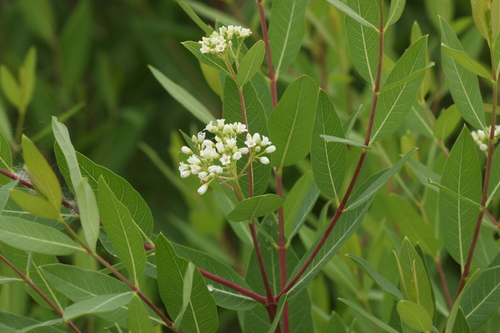
Apocynum cannabinum L. grows up to 1 metre (3 feet 3 inches) tall. Its stems are reddish and contain milky latex. The leaves are opposite, simple, broad, and lanceolate, measuring 7–15 cm (2+3⁄4–6 in) long and 3–5 cm (1+1⁄4–2 in) broad. The leaves have smooth edges, are smooth on the upper surface, and have white hairs on the underside. This species flowers from July to August, with large sepals and a five-lobed white corolla. Its flowers are hermaphrodite, meaning they contain both male and female reproductive organs. The plant's seeds have white, silky hairs to help them disperse via wind; their light weight also lets them disperse via water. Its root system is made up of short rhizomes and horizontal roots. Apocynum cannabinum grows in open wooded areas, ditches, hillsides, and human-disturbed habitats. It prefers gravelly or sandy soil, most often in shady or moist locations near streams. It is native to most of North America, occurring across the southern half of Canada and throughout the United States. In ecological terms, this plant is a larval host for the snowberry clearwing (Hemaris diffinis), a pollinator that looks like a small hummingbird. It also acts as a host plant for the dogbane tiger moth (Cycnia tenera) and the zebra caterpillar (Melanchra picta). Larvae of Marmara apocynella feed on the plant's stems, creating long whitish serpentine mines. Indian hemp is primarily pollinated by insects, which are drawn to the fragrance and nectar of its flowers. Apocynum cannabinum is poisonous to humans, dogs, cats, and horses. All parts of the plant are toxic, as they contain cardiac glycosides, and the plant remains toxic whether it is fresh green or dried. The white sap held in the stems can cause skin blisters. The seeds of the plant are edible when ground into a powder, which can be eaten raw or cooked as a meal. In herbal medicine, this plant is used to treat fever and slow the pulse. A range of Native American tribes have used Apocynum cannabinum to treat a wide variety of ailments, including rheumatism, coughs, pox, whooping cough, asthma, internal parasites, and diarrhea; it has also been used to increase lactation. The root, harvested in autumn and dried for later use, has been used as a tonic, cardiotonic, diaphoretic, diuretic, emetic (to induce vomiting), and expectorant. The fresh root is the most medicinally active part of the plant. A weak tea made from dried root has been used for cardiac diseases and as a vermifuge (an agent that expels parasitic worms). The plant's milky sap is used as a folk remedy for genital warts. However, both illness and death have occurred from the medicinal use of this plant.