About Aplysina insularis (Duchassaing & Michelotti, 1864)
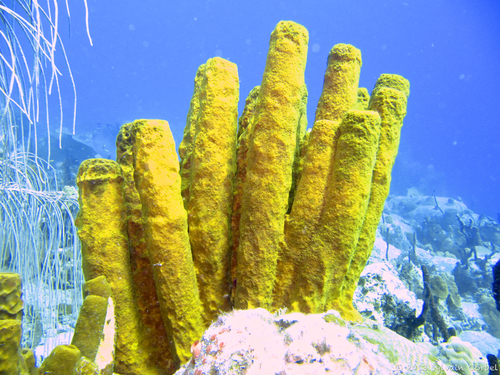
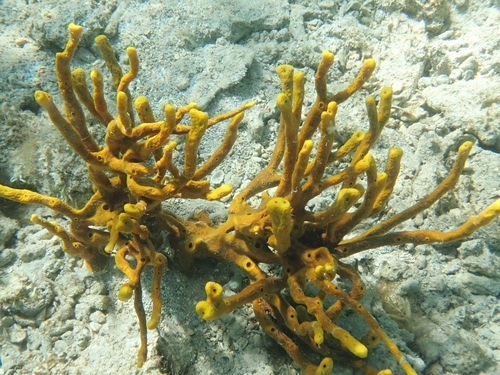
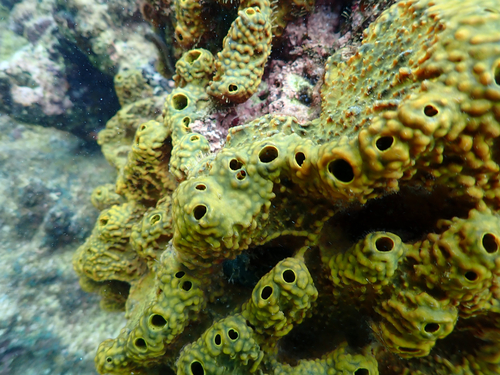
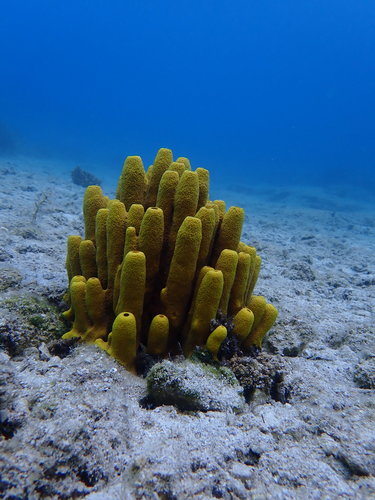
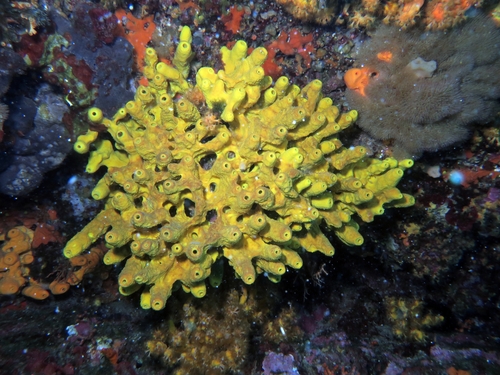
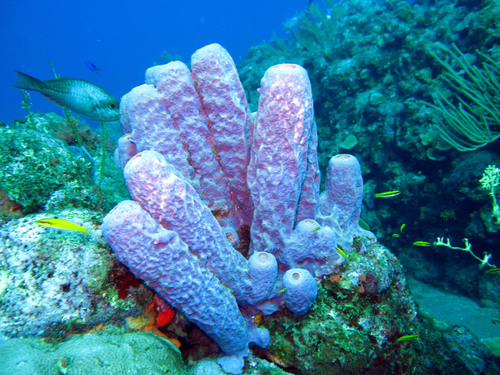
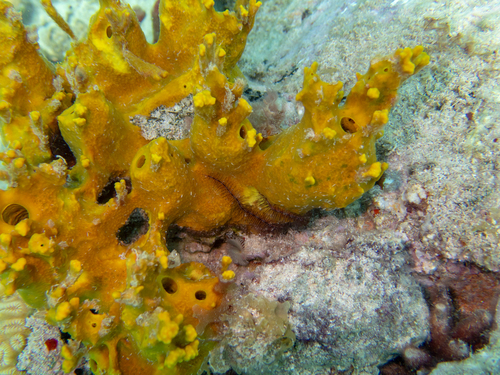
Aplysina insularis is a large sponge that consists of one or more cylindrical tubes joined together at their base. Each tube narrows at the apex into a large osculum, which may be surrounded by small, finger-like projections. The sponge can also develop slender tendrils and larger rope-like projections; in areas with high sedimentation, these projections can grow larger than the tubes themselves. This species can reach 50 centimetres (20 in) in length, with individual tubes growing up to 8 centimetres (3.1 in) in diameter. Its texture is soft but tough, and its outer surface is either smooth or covered in fine conical projections. There are no silicaceous spicules in the sponge wall; instead, the wall is strengthened by a network of fibres arranged in a hexagonal or circular mesh pattern. The sponge is naturally yellowish brown, but in deeper water it shifts to an intense greenish yellow. This colour change occurs because its surface layers fluoresce under the blue-only light that penetrates to these depths. If the sponge is bruised or removed from water, it turns dark purple or black, and exudes a substance that can stain human skin, leaving a mark that is very difficult to remove. Aplysina insularis is found in Bermuda, Florida, the Bahamas, the Virgin Islands, the Greater Antilles, the Caribbean Sea, the northern half of the Gulf of Mexico, and northern Brazil. It is a moderately deep-water species, found at depths down to around 40 metres (130 ft) on reefs, especially on outer reef slopes and vertical walls. A number of animals live inside the protective central lumen of this sponge, including the sponge cardinal fish Phaeoptyx xenus and several species of neon goby Elacatinus spp.