About Aplysina fistularis (Pallas, 1766)
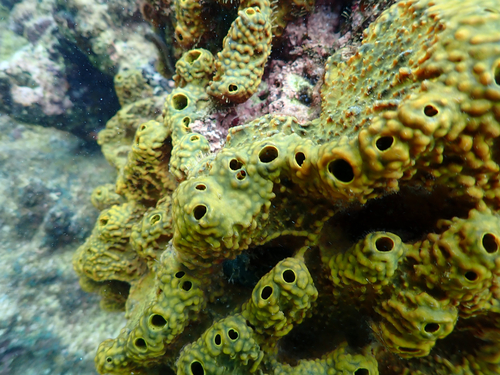
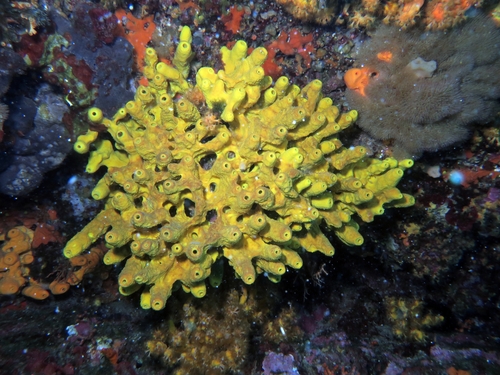
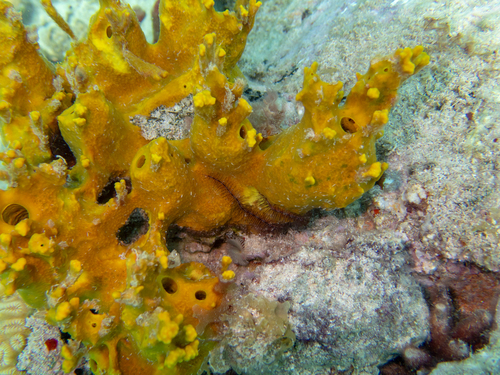
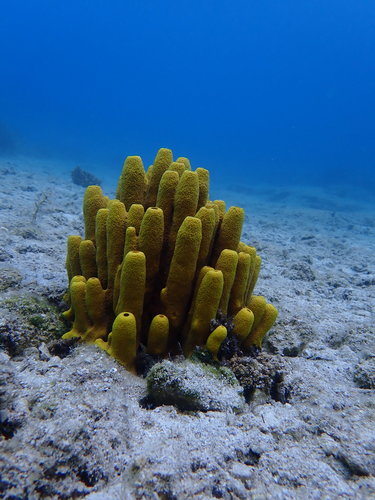
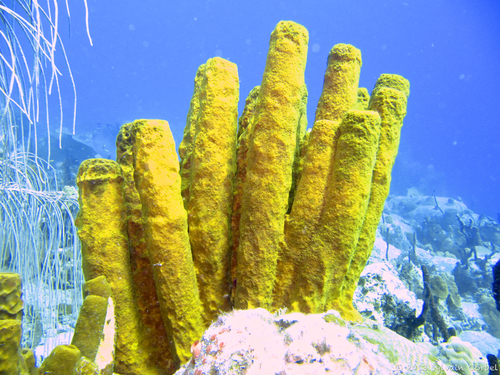
Aplysina fistularis (Pallas, 1766) is a sessile sponge made up of one or more yellow tube-shaped structures that grow from a closed base. It has wide oscula, thin walls, and ridged outer surfaces. In clear water, individual tubes rarely grow longer than 30 centimetres (12 inches), but they can reach up to 50 centimetres (20 inches) on reefs in turbid zones. Unlike the related species Aplysina insularis, A. fistularis does not develop rope-like projections around its tubes, though it may grow some branching tendrils. Unlike most sponges, A. fistularis does not have a silicate skeletal structure. Before synthetic sponges were invented, this species was used as a bath sponge. A. fistularis produces antimicrobial compounds year-round, and has potential to support future development of new antibiotics to combat antimicrobial resistance. Its primary predator is the hawksbill turtle. Aplysina fistularis can reproduce both sexually and asexually. Asexual reproduction typically only happens when a fragment of the sponge breaks off from the main body. Newly grown sponges need a hard surface to attach to and grow on. If a reef is heavily disturbed, for example by being covered in algae or sediment, A. fistularis may have difficulty establishing and growing.