About Aplysina cavernicola (Vacelet, 1959)
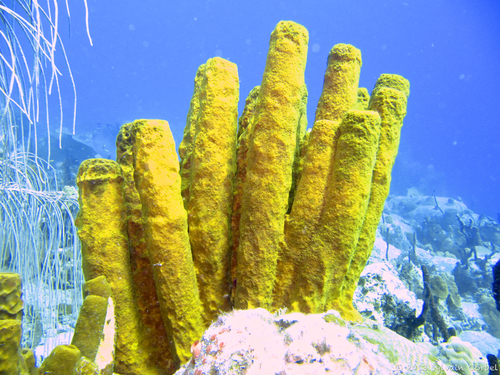
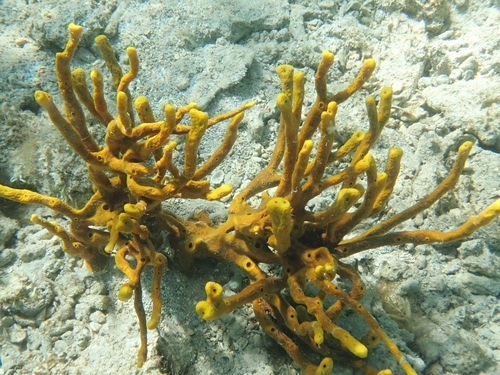
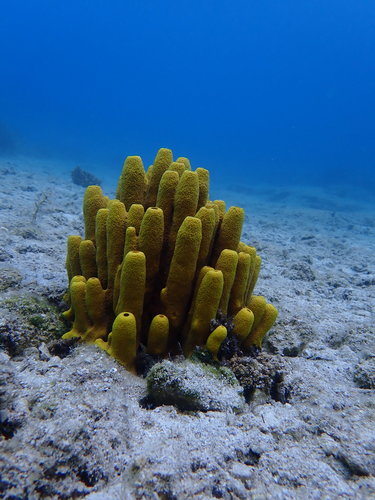
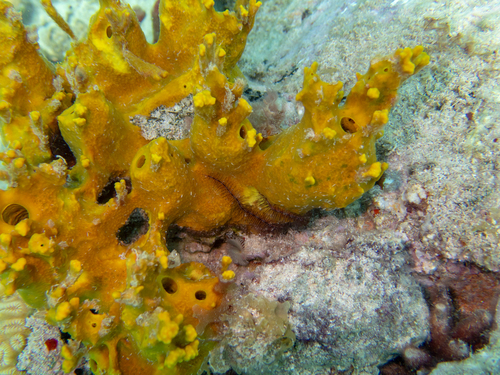
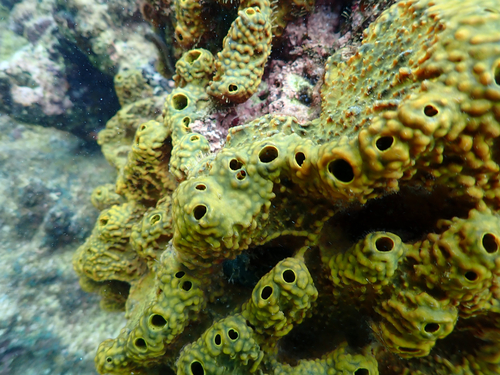
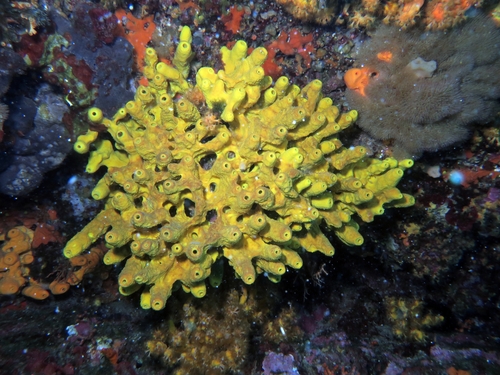
Aplysina cavernicola forms clumps that can grow up to 30 cm (12 in) across. It has a base that adheres to rock or other hard surfaces, from which multiple finger-like processes grow; these processes reach up to 6 cm (2.4 in) in length and 2 cm (0.8 in) in diameter. Its surface is sparsely covered in small conical protrusions, formed by the tips of horny fibres embedded in its tissues. This sponge has no spicules, and gets its structural support from a mesh of spongin fibres. Water is drawn in through small pores called ostia at the base of the sponge, and ejected through oscula, which sit in shallow depressions at the tips of the finger-like processes. The body of Aplysina cavernicola is yellowish in colour. Ecologically, this sponge is a hermaphrodite. It releases ciliated parenchymella larvae into the water column; these larvae quickly settle on suitable substrate and undergo metamorphosis to become juvenile sponges. This sponge accumulates brominated isoxazoline alkaloids in its tissues, reaching concentrations as high as 10% of its dry body weight. Feeding trials that incorporated these biologically active compounds into experimental diets have confirmed that the compounds are distasteful to Blennius sphinx (the sphinx blenny), a polyphagous Mediterranean fish, while the fish readily eats other sponges. Certain metabolic derivatives of these isoxazolines, including dienone and aeroplysinin, are not distasteful to the fish, but may have anti-microbial properties that protect the sponge from bacterial pathogens. Aplysina cavernicola also bioaccumulates radionuclides, and has been used as a model organism to study the presence of isotopes like americium-241 in seawater.