About Aplysina cauliformis (Carter, 1882)
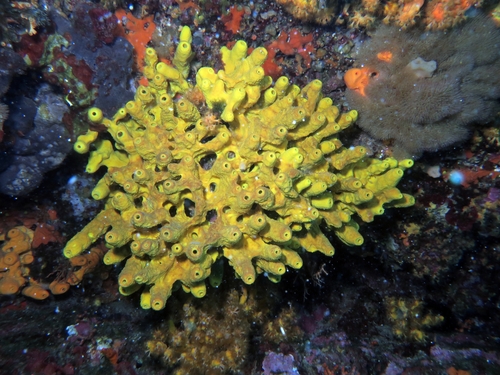
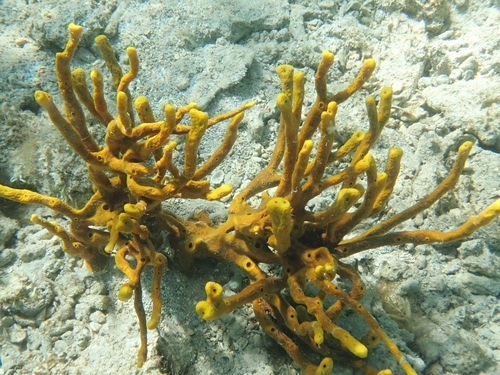
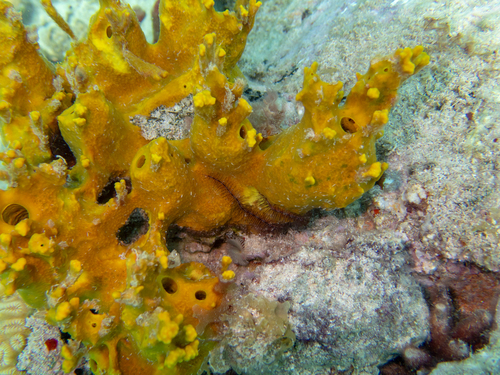
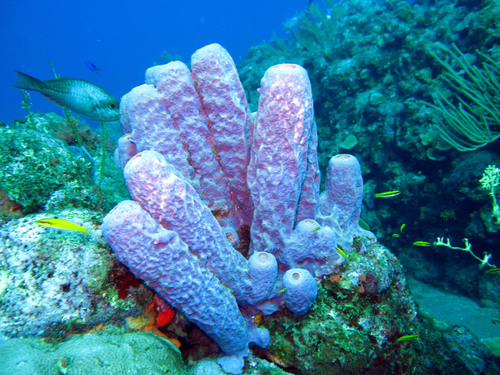
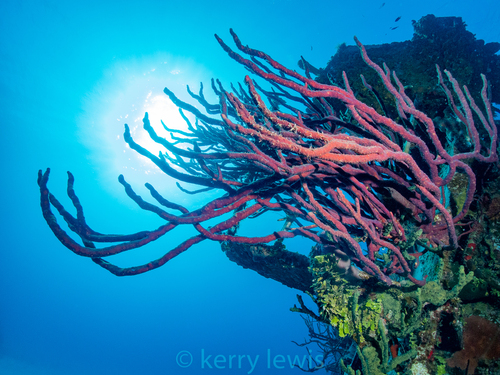
Aplysina cauliformis is a sponge species that has two distinct color morphologies. One variant is light brown or pink and usually grows vertically, while the purple variant grows in a creeping pattern along the substrate or around other reef organisms. This species has a branching growth form, developing long, thin branches instead of thick tubes that contain oscula. Its branches typically measure 20 to 60 cm (7.9 to 23.6 in) in length, and 0.5 to 3 cm (0.20 to 1.18 in) in width. While many sponges have skeletons formed of spicules—microscopic structural elements made of either calcium carbonate or silica—sponges in the class Demospongiae do not always have spicules, and may instead rely on a supportive skeleton made of collagenous spongin and chitin. The surface of Aplysina cauliformis is covered in tiny oscula, which are small openings that water passes through the sponge. Sponges of the genus Aplysina are generally found throughout the Caribbean basin, though some members of the genus have been found along the coast of South America. Most recorded observations of Aplysina cauliformis are from shallow-water coral reefs, where sponges are starting to make up a larger portion of the reef foundation than corals due to warming ocean temperatures. The species' typical depth range is 2 to 20 m (6.6 to 65.6 ft). Some individual sponges have been observed at 50 m (160 ft) deep, where light is far more limited than in shallow water. Branching sponges typically reproduce asexually: the tips of their branches break off, drift away with currents, and settle in new locations. A broken branch can grow into a genetic clone of the original sponge if it successfully establishes itself, and the original sponge will regrow the lost branch. Since A. cauliformis has a branching morphology, it uses this asexual reproduction method, but it is also capable of sexual reproduction, though it allocates very little biomass and energy to sexual reproduction.