About Aplysina aerophoba (Nardo, 1833)
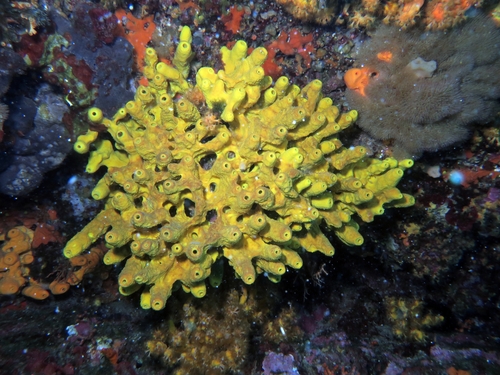
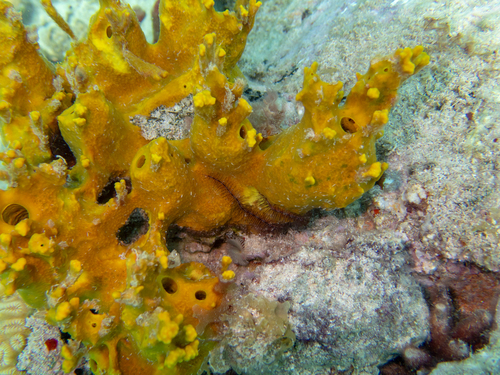
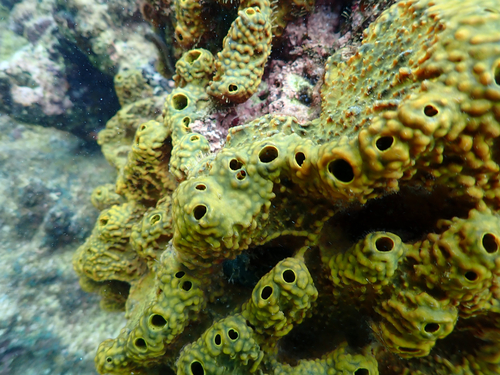
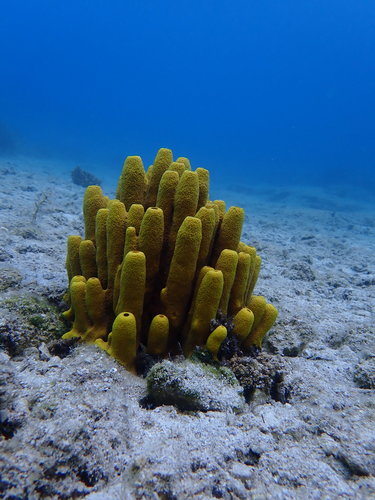
Aplysina aerophoba (Nardo, 1833) forms colonies that reach up to 1 meter (3 feet) across, made up of irregular, yellow tubular processes. Individual tubes grow up to 4 cm (1.6 in) long and 2.5 cm (1.0 in) wide, with small oscula (exhalant pores) at the center of their flattened ends. Both the basal mass and the tubes have small, cylindrical projections of varying length across their surface. The surface feels slippery, and the overall texture is firm and rubbery. When taken out of water, this sponge turns blue, which gives it its specific name 'aerophoba', meaning 'fear of air' in Greek. This species can be mistaken for another yellow sponge, Aplysina cavernicola, but the two differ in texture, morphology, pigmentation, and habitat: A. aerophoba occurs in sunlit areas, while A. cavernicola lives in marine caves. A distinct dwarf yellow sponge was discovered in the Mediterranean in the early 21st century, and genetic analysis has confirmed it is a miniature form of A. aerophoba. The dwarf form is bright sulphur yellow, and grows as small lobular patches on rock surfaces. These patches do not usually touch one another, though they may have hidden connections underground. Each lobe measures between 2 and 15 mm (0.1 and 0.6 in) in diameter, and often bears small, slender cylindrical projections a few millimeters long. Its surface is pitted with small puncture marks that correspond to inhalant pores, and its oscula are very small, usually less than 1 mm in diameter. Aplysina aerophoba is primarily a Mediterranean species, but it also occurs in adjacent Atlantic areas off Portugal and northwestern Spain, and it is common in the Canary Islands. It occurs at depths ranging from the lower intertidal zone down to around 20 m (70 ft), and is most often found in sunlit locations. The dwarf form is found at a small number of Mediterranean sites, including Liguria, Provence and Corsica, where it lives in caves and under overhangs in very shallow water. This sponge feeds by drawing water in through small inhalant pores called ostia at its base, then ejecting the filtered water through its oscula. It filters out organic food particles including bacteria, unicellular algae, and fine detritus. It is hermaphroditic: gametes are released into the water column where fertilization takes place, and the resulting larvae are planktonic. Larvae soon settle on suitable substrate and undergo metamorphosis to become juvenile sponges. Under the right conditions, this sponge can also produce buds that detach from the parent sponge to grow into new independent colonies.