About Aplysia morio (A.E.Verrill, 1901)
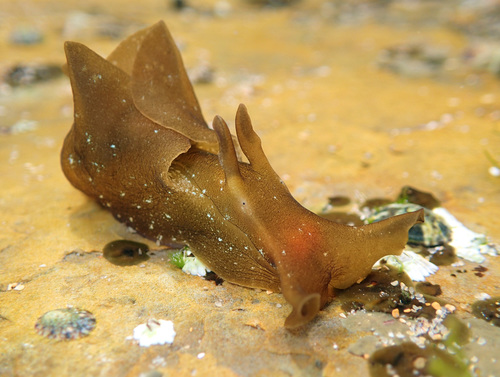
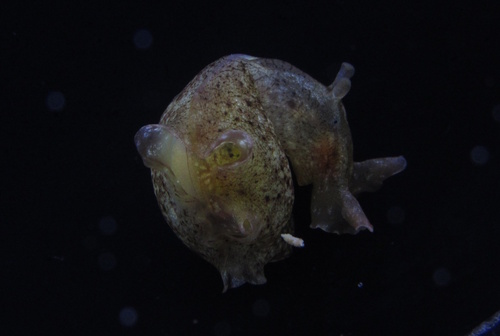
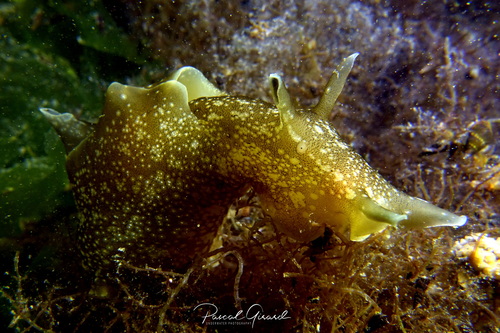
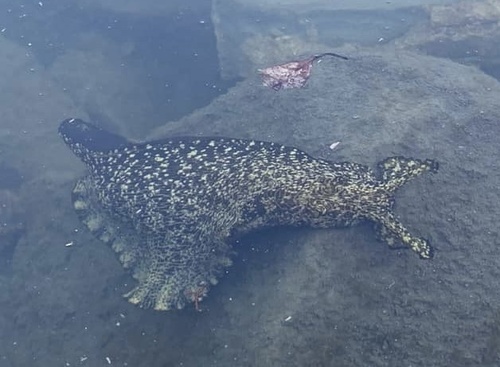
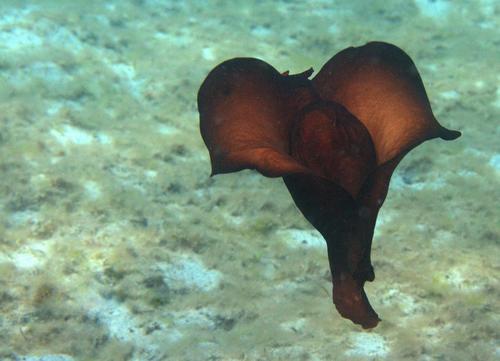
Aplysia morio is a very large bulky sea slug, exceeding one foot (over 30 cm/12 inches) in length; the recorded length of a non-fully extended live individual is 400 mm, with a height of 145 mm. This species is typically dark umber-brown, dark chocolate brown, or nearly black in color, with no definite spots. The head and neck are thick and robust, and the head is marked with several narrow purplish-black longitudinal stripes; dark lines may also be visible on the flanks. The body is thick, stout, swollen, and very obtuse posteriorly. It has very large, broadly overlapping lateral flaps called parapodia that are used for swimming. These lateral natatorial flaps are very wide, overlapping by about half their breadth, completely free posteriorly, and extend to the end of the short foot. The rhinophores are rather small, short, and conical. The tentacles are large, very broad, and foliaceous with thin expanded margins; they are curled and shaped like rabbit ears, rich in nerve cells, and equipped with receptor organs. The body and outer surfaces of the flaps are very dark umber-brown or brownish-black, with a few obscure dusky blotches on the sides of the foot and a purplish tinge along the edges of the flaps. The internal shell is hidden within the mantle, is very thin, transparent, pale yellow, fragile, and oblong-ovate in shape, roughly disc-like. The shell is obtusely rounded anteriorly, with a long, only slightly incurved posterior sinus. Its beak is rather prominent, barely incurved, with a reflexed membranous edge that extends along both posterior margins. No calcareous layer is present in formalin-preserved specimens. The shell surface has concentric undulations and faint longitudinal grooves, with an approximate length to breadth ratio of 3:2 (measured as 60 mm length, 40 mm breadth). No mantle pore could be found, nor a distinct pore for the opaline gland; this gland likely discharges through numerous minute openings. This species is found in the semi-tropical western Atlantic Ocean. Its range covers the eastern coast of the United States, Florida, Bermuda, the West Indies, the Caribbean Sea, the Gulf of Mexico, and Venezuela. It typically inhabits shallow water down to around 40 m (130 ft) in areas with little wave action. It is most often found on rocky surfaces among the algae it feeds on, and can also occur on sandy seabeds. Aplysia morio feeds on algae. In Bermuda, juvenile individuals feed almost exclusively on red algae species from the genus Laurencia, even when a wide variety of other algae are available. Adult Aplysia morio expand their diet slightly to include Palmaria palmata. The species crawls over seaweed, or rears up to grasp algal fronds with its radula and the supporting odontophore cartilage. It may also swim in a manta ray-like manner when searching for food. Adult Aplysia morio are hermaphrodites that can function as both male and female at the same time. When one individual inserts its penis into another’s genital opening, this can lead to the formation of chains or clusters of mating sea hares. An initial spawning individual releases chemical signals that can trigger spawning in other individuals, which can result in a mass spawning event. Fertilized eggs hatch into veliger larvae, which drift with plankton for at least a month before settling onto Laurencia seaweed.