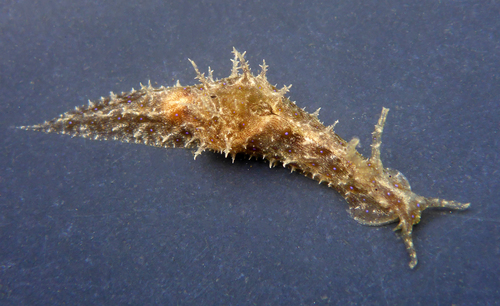
About Aplysia dactylomela Rang, 1828
The spotted sea hare, Aplysia dactylomela Rang, 1828, has highly variable body coloration, ranging from pale gray and green to dark brown. Its mantle almost always features large black rings, and the maximum recorded body length is 410 mm. Its internal shell is solid, hatchet-shaped, and pale straw-colored, marked by widely spaced concentric undulations. The shell is highly oblique and deeply convex, with a shelly (testaceous) interior. Its apex is significantly elevated, strongly curved inward, and noticeably calloused. The upper shell margin is deeply excavated, broadly reflected, and pointed (acuminated) at its tip. The outer lip is extended and rounded, while the dorsal margin is rounded at the top, slopes downward toward the outer lip, and has an arched, excavated shape.
Traditionally, this sea hare species was considered cosmopolitan, found in nearly all tropical and warm temperate seas, including the Mediterranean Sea where it was first recorded in 2002, and likely became self-established due to rising ocean temperatures. Genetic evidence has now reclassified the Indo-Pacific population as a separate species, Aplysia argus, which restricts the range of true A. dactylomela to the Atlantic Ocean region, including the Caribbean and Mediterranean. The two species look very similar, though A. argus has more variable color and patterning.
A. dactylomela is commonly found in shallow waters, tide pools, and on rocky and sandy substrates, and it also feeds in seagrass beds. During the day, it mostly hides under large rocks and in crevices. While it typically stays in relatively shallow water, it has been recorded as deep as 40 m; minimum recorded depth is 0 m, and maximum commonly recorded depth is 3 m.
For human use in research, the right giant neuron located in the abdominal ganglion of A. dactylomela is structurally similar to vertebrate neurons, making it ideal for electrophysiology studies and conditioned-response research. These neurons have proven invaluable to neurological research, because they allow researchers to detect long-lasting changes in neuronal behavior.