About Aplysia californica J.G.Cooper, 1863
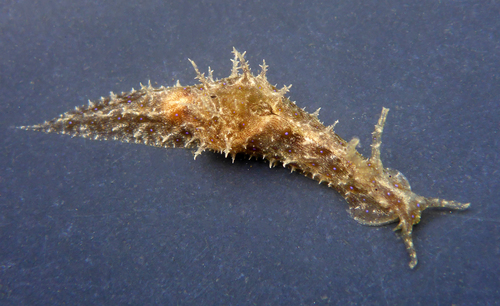
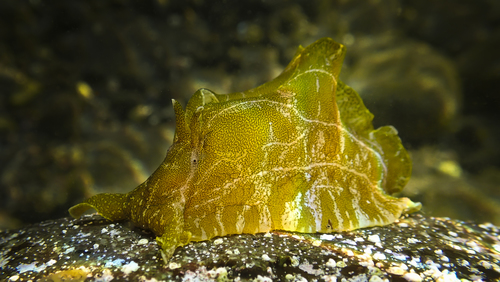
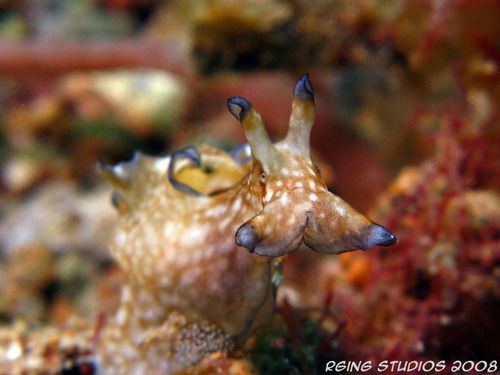
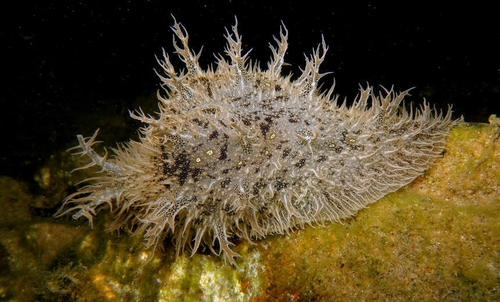
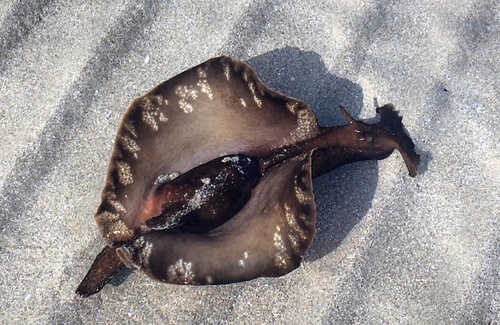
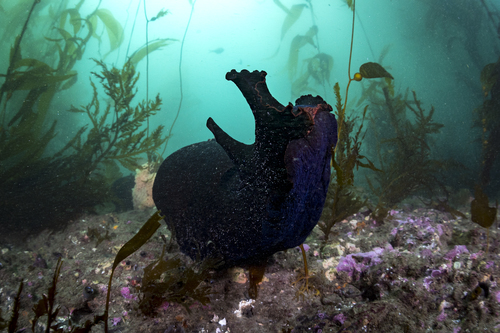
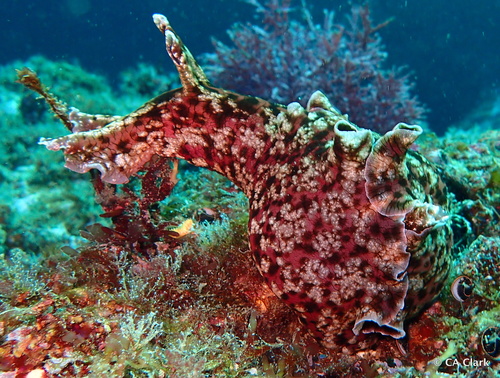
Aplysia californica, commonly known as the California sea hare, reaches a maximum recorded fully extended crawling length of 75 cm (30 in), though most adult specimens are half this size or smaller. Adult individuals can weigh up to 7 kg (15 lb). A close relative, Aplysia vaccaria (the black sea hare), can grow even larger. The species' base coloration ranges from pale gray to greenish, shifting to purplish on the sides. Scattered white specks mark the mantle folds, and an irregular network of brown lines extends from these specks across the rest of the body, interspersed with large brown blotches. The inner surface of the mantle has a distinctive pattern of alternating, interlocking bars of white and dark brown. The sole of the foot is black, and the very small eyes are black. The California sea hare's shell is embedded within the cartilaginous tissue of the mantle; it is translucent and shaped like a trapezoid or hatchet, with rounded margins and a slightly convex dorsal surface. In older specimens, the central nucleus sits far from the posterior end, or apex. Faint radiating lines spread out from the nucleus, crossed by an irregular network of darker lines. All these lines end abruptly at a distance from the shell's margin, creating a wide, nearly transparent border. A flat, spoon-shaped, slightly raised accessory plate grows from the nucleus on the shell's inner surface. California sea hares are often reddish-brown to greenish-brown, but their final color varies based on the algae they eat. Each individual has four tentacles: two on the head that shelter the eyes, and two on the face that surround the mouth. The body has two folds called parapodia that enclose the gills for protection while still allowing water to pass through. A foot-like muscle below the body enables movement, and the species also has an internal shell that protects internal organs. Aplysia californica is found along the coast of California in the United States, and in northwestern Mexico including the Gulf of California. Species in the Aplysia genus live in the photic zone to graze on algae, mainly in intertidal areas, and usually do not occur deeper than 18–20 m (59–66 ft). In this species, the penis can protrude from an opening at the base of the right anterior tentacle. The genital aperture is at the anterior end of the mantle cavity, and a seminal groove runs forward from this aperture to the penis at the base of the anterior tentacle. Coupling lasts for hours or sometimes days, even though the actual transfer of sperm may only take a few minutes. Egg laying is normally triggered by copulation, but isolated individuals can lay eggs spontaneously after being kept alone for up to 3–4 months; these eggs are typically unfertilized. Copulation happens most often in the early morning, and rarely occurs after 12:30 pm. One 2,600 g individual was recorded laying roughly 500 million eggs across 27 separate laying events in less than five months. Aplysia californica is a valuable laboratory animal used in studies of the neurobiology of learning and memory, and is especially connected to the work of Nobel laureate Eric Kandel. It is widespread in studies of synaptic plasticity because it has a simple nervous system made up of just 20,000 large, easily identified neurons, with cell bodies up to 1 mm in size. Despite its simple nervous system, Aplysia californica is capable of many nonassociative and associative learning tasks, including sensitization, habituation, and both classical and operant conditioning. Common research work uses a reduced preparation of the gill and siphon withdrawal reflex. Sequencing of the full A. californica genome was approved as a priority by the National Human Genome Research Institute in March 2005, and the draft genome is available on the UCSC Genome browser.