About Aplysia argus Rüppell & Leuckart, 1830
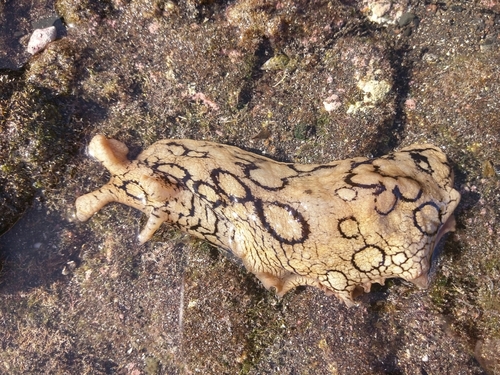
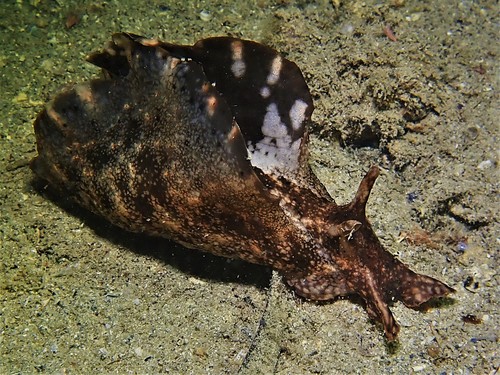
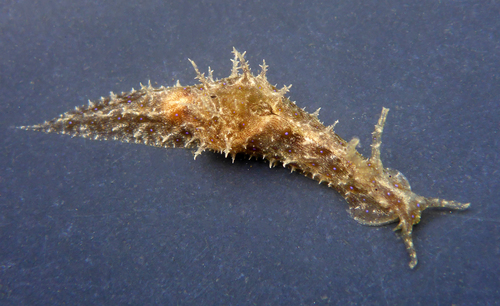
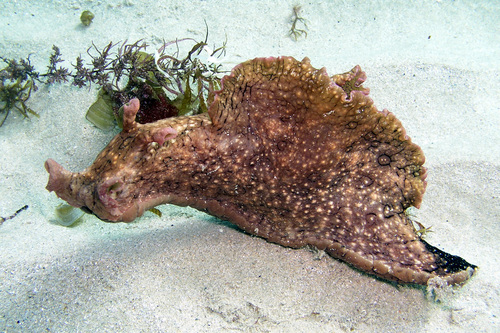
Aplysia argus, commonly called a sea hare, was first described by Rüppell & Leuckart in 1830. The original Latin description characterizes it as having an olive-colored body, with ocellated (eye-like) spots scattered across its entire back. Each of these ocelli is made up of a whitish central spot surrounded by a dark-brown margin. For a long time, this species was confused with the Atlantic-dwelling Aplysia dactylomela, because the two species are very similar in morphology. However, genetic studies have confirmed that the sea hare population found in the Indo-Pacific is actually a distinct species, Aplysia argus. Aplysia argus is a very small sea hare, growing to a maximum length of 8 inches. Individuals range in color from gray to brown, with white specks and brown or black rings. This species is native to the Indo-Pacific region, and has been recorded in areas including the Hawaiian Islands, French Frigate Shoals, Laysan, Midway, and Kure. It inhabits shallow rock-surrounded seawater pools, at depths between three and six feet. It is a nocturnal species; during the day, individuals hide underneath rocks. Most individuals of this sea hare stay close to their own egg masses.