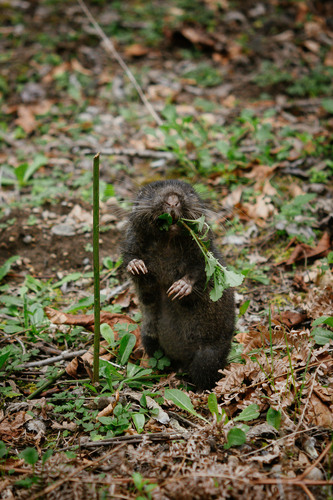
About Aplodontia rufa (Rafinesque, 1817)
Mountain beavers (scientific name Aplodontia rufa) typically have dark gray or brown fur, though fur color can range from more reddish to more blackish across different subspecies, with a light patch located under each ear. These animals have characteristically short tails. Adult mountain beavers weigh 500–900 g (18–32 oz), with a small number of individuals exceeding 1,000 g (35 oz). Their total body length ranges from 30–50 cm (12–20 in), while tail length measures 1–4 cm (0.39–1.57 in). Their surface similarity to true beavers only comes from their relatively large size for rodents, strong body odor, preference for extremely wet or moist habitats, and tendency to gnaw bark and cut branches. Unlike true beavers, mountain beavers do not fell trees, build dams, live in lodges, or communicate by slapping their tails, as their tail is very small. Their above-ground activities are predominantly nocturnal and crepuscular. They are known to climb a few meters up trees to get branches and leaves for food; for the most part, however, their diet consists mostly of ferns, particularly species that are toxic to other animals. The mountain beaver skull is protrogomorphous, with no specialized attachments for masseter muscles, which differ from the skulls of other rodents. It is flattened and lacks a postorbital process. The baculum is thin and distinctly forked, and the penis measures around 4.5 cm (1.8 in) in length. Males do not have a true scrotum, but their testes move into a semiscrotal position during breeding season. Mountain beavers have an unusual projection on each molar and premolar tooth that is unique among mammals, making their teeth easy to identify. On the upper tooth row, this projection points toward the cheek, while on the lower tooth row it points toward the tongue. Their cheek teeth do not have the complex folds seen in other rodents, and instead consist of single basins. They are hypsodont and ever-growing. Mountain beavers have two upper premolars, one lower premolar, and a full set of molars, giving them a dental formula of 1.0.2.3 / 1.0.1.3. Mountain beavers cannot produce concentrated urine. It is thought that they are physiologically restricted to temperate rainforest regions of the North American Pacific coast and moist inland microenvironments, because they cannot get enough water in more arid environments. The hypothesis also states that Aplodontia prefer vegetation with high water content because of their poor ability to concentrate urine, which requires them to consume large amounts of water every day. Mountain beavers range from the Cascade Mountains of British Columbia south through the rest of the U.S. Cascade Range, the Olympic Mountains and Coast Ranges of Washington and Oregon, the Klamath Mountains, the Sierra Nevada, Point Arena and Pt. Reyes in California, and extreme western Nevada. They occur from sea level up to the tree line, and can live in both deciduous and coniferous forests, though they appear to prefer deciduous forests across most of their range. Known predators of mountain beavers include bobcats, coyotes, weasels, cougars, golden eagles, and owls. One of the parasites that infects mountain beavers is Hystrichopsylla schefferi, the largest known flea species; females of this flea can reach 8 mm (0.31 in) in length. In parts of the Pacific Northwest, mountain beavers are considered pests, because they cause extensive damage to forest trees via basal bark grinding, branch cutting, and clipping of small saplings and seedlings. This damage often creates problems for forest management and reforestation, as small seedlings may be buried or uprooted during feeding, and damage can lead to tree deformities, suppressed growth, and tree mortality. The United States Forest Service has run a program to exterminate mountain beaver populations due to the economic damage they cause to commercial reforestation. Damage control measures to protect forest trees by managing mountain beaver populations include trapping, placing toxic baits, and installing physical barriers such as plastic mesh tubes around the base of individual trees.

