About Aplodactylus westralis Russell, 1987
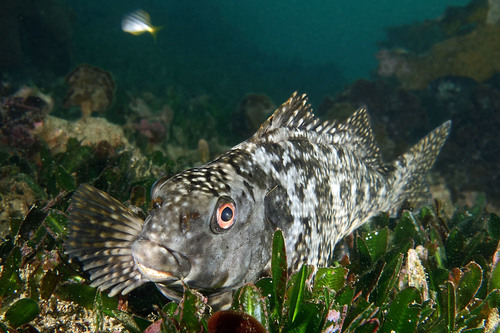
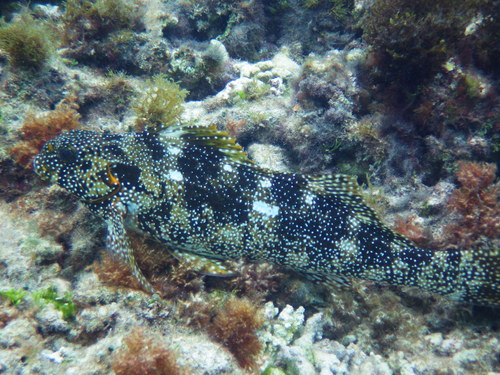
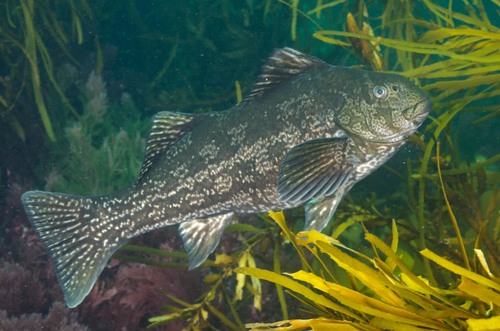
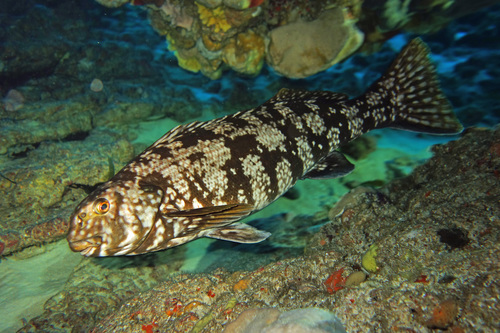
Aplodactylus westralis has an elongated body, with body depth equal to between one-quarter and one-fifth of its standard length. It has a short snout, rounded head, and a small, slightly downturned mouth with fleshy lips; the upper lip projects forward. The jaws hold small, lanceolate teeth arranged in 5 to 6 rows, with the largest teeth located in the outermost row. There is also a small crescent-shaped patch of vomerine teeth. This species has two pairs of nostrils; the front pair features a fleshy flap with small tentacles on both its front and rear margins. A wide, flattened spine sits in the operculum, and this spine does not extend to the operculum margin. The dorsal fin has a long base, and is almost divided in two by a deep, wide incision between its spiny and soft-rayed sections. The dorsal fin contains 17 to 18 spines and 18 to 19 soft rays, while the anal fin contains 3 spines and 7 soft rays. It has large pectoral fins that may be longer than the head, and the lowest 5 to 6 pectoral fin rays are unbranched and fleshy. The body is covered in small, embedded cycloid scales that also extend onto the cheeks and operculum, and form a sheath along the base of the spiny portion of the dorsal fin. The maximum recorded total length for this species is 34.7 cm (13.7 in). The overall body color is brown or slaty grey, marked with six dark saddle-shaped blotches on the back and upper flanks. Below the lateral line, these dark markings become irregular bars that continue onto the midline of the abdomen. The skin between the dark saddles and bars is pale brown or whitish; these pale areas are sometimes very small or merge to form pale mottling. Abundant light brown or whitish spots, roughly equal in width to the diameter of a fish pupil, are present mainly on the head, and on the caudal, dorsal, and anal fins. Aplodactylus westralis is endemic to southwestern Australia, ranging from the Yorke Peninsula in South Australia to Rottnest Island in Western Australia. It is a common fish found on rocky reefs with seaweed beds, at depths down to 20 m (66 ft).