About Aplodactylus lophodon Günther, 1859
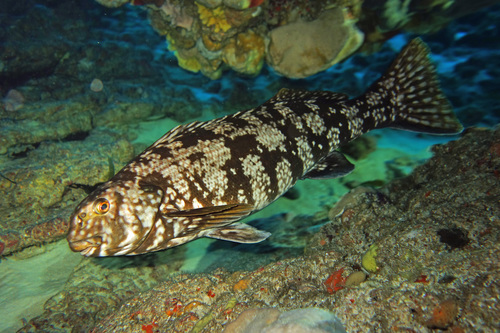
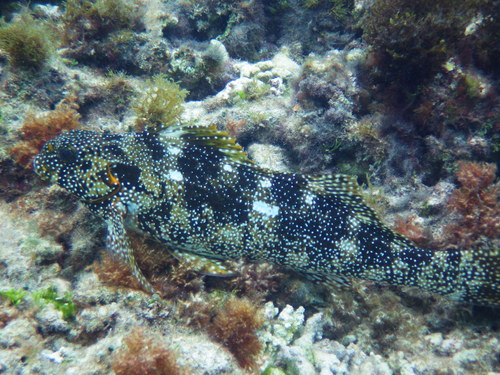
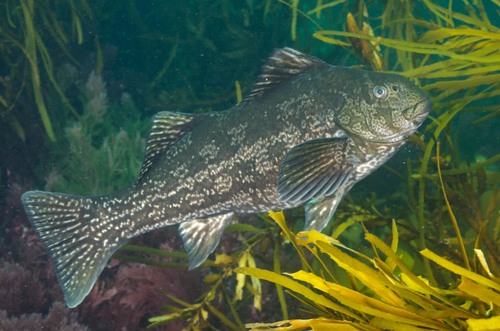
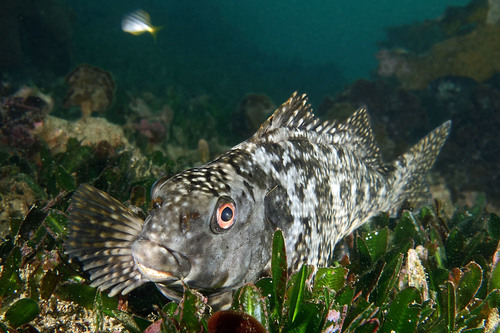
The rock cale (Aplodactylus lophodon Günther, 1859) has an elongated body, with its body depth equal to roughly one-quarter to one-third of its standard length. It has a rounded head with a short snout, a small slightly downturned mouth, and fleshy lips, with the upper lip projecting outward. The jaws hold small tricuspid teeth, plus a small number of sharply pointed teeth, arranged in 3 to 4 rows across the jaws. The outermost row contains the largest teeth, and there are no teeth on the vomer. There are two pairs of nostrils; the front pair has a fleshy flap with small tentacles on both its front and rear margins. A wide, flattened spine is present in the operculum, and this spine does not reach the opercular margin. The dorsal fin has a long base, and is nearly divided in two by a deep, wide notch between its spiny and soft-rayed sections. The dorsal fin contains 17 spines and 18 to 20 soft rays, while the anal fin contains 3 spines and 6 to 7 soft rays. It has large pectoral fins that may be longer than the head; the lowest 5 to 6 pectoral fin rays are unbranched and fleshy. The body is covered in small cycloid scales that are embedded in the skin; these scales extend onto the cheeks and operculum, and form a sheath along the base of the spiny portion of the dorsal fin. The maximum recorded total length of this species is 45 cm (18 in). The overall body color of the rock cale ranges from grey to bluish-black, with irregular whitish mottles on the flanks and whitish spots on the fins. A dark saddle-shaped blotch is located underneath the middle of the spiny part of the dorsal fin, and a line of five evenly spaced white blotches runs along the flank below the lateral line, starting above the pectoral fin and ending under the rear end of the dorsal fin. Juvenile rock cales have a distinct black mark on the upper rear edge of the operculum. The rock cale is endemic to the southeastern Australian waters of the southwestern Pacific Ocean. Within this region, it occurs from Mudjimba on Queensland's Sunshine Coast, south to the Gippsland Lakes in Victoria, and out to Babel Island off Tasmania. It inhabits shallow, exposed rocky shores, and forms schools in the high-energy zone just below the surface, down to depths of around 10 m (33 ft), where kelp and other seaweeds form abundant cover.