About Aplidium californicum (Ritter & Forsyth, 1917)
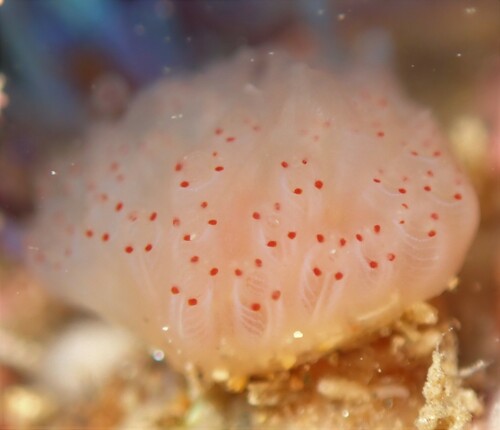
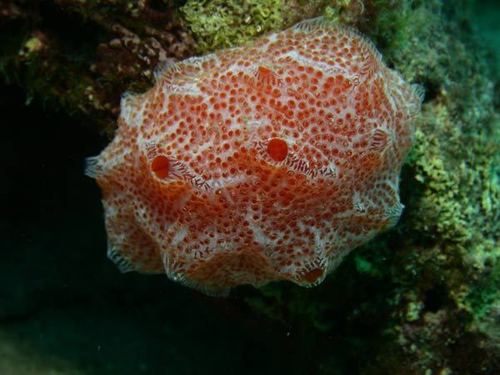
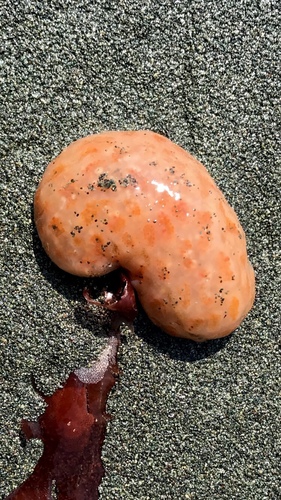
Aplidium californicum is a compound tunicate that forms sheets, mounds, or slabs that grow on rocks and other hard substrates. Its tunic has a jelly-like consistency, measures 1 to 3 cm thick, and can be coloured shiny yellow, orange, reddish-brown, or translucent white. The individual zooids of this species are brown or buff, 6 mm long, and arranged in oval or elongate systems. Each zooid is subdivided into three regions: a thorax, an abdomen, and a postabdomen, and typically has 10 to 12 rows of perforations. Aplidium californicum is common along the west coast of North America, ranging from British Columbia south to Baja California, Mexico, and extending to the Galapagos Islands. It occurs in the intertidal zone and at depths of up to 85 metres.