About Apletodon dentatus (Facciolà, 1887)
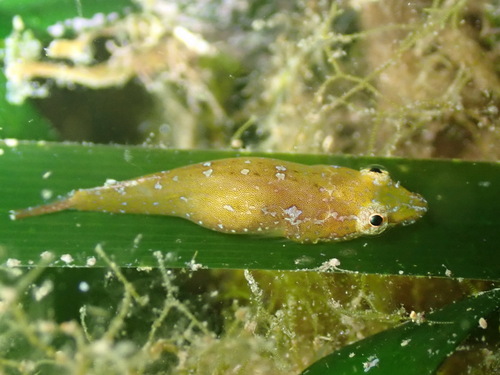
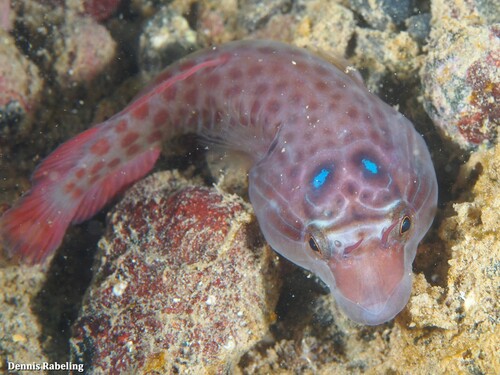
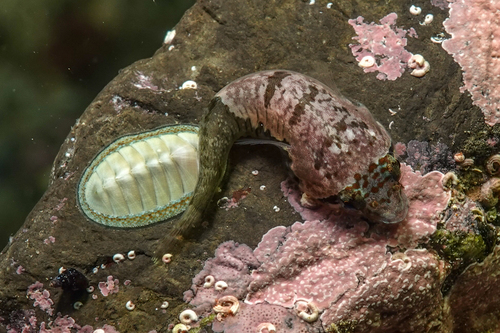
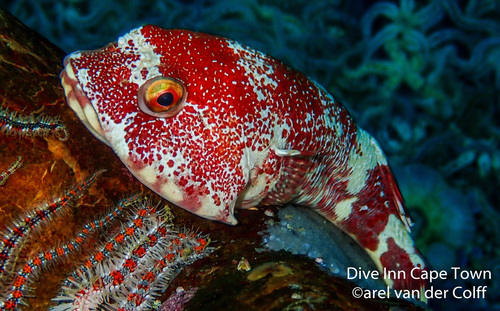
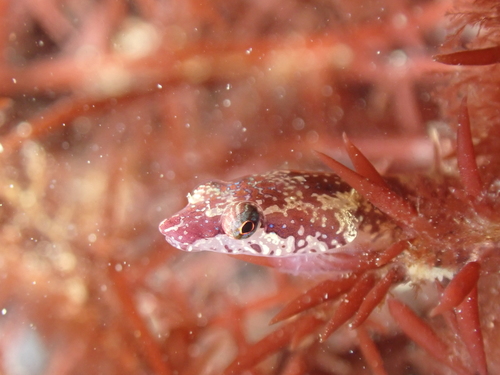
Apletodon dentatus is a small fish species that grows to a maximum total length of 4 centimetres, or 1.6 inches. When viewed from above, it has a depressed, triangular head. Its dorsal and anal fins are short, rounded, and positioned close to the caudal fin, which is also rounded, just like the pectoral fin. The pelvic fin is modified into a suction disc that the fish uses to attach itself to underwater substrates. This species has variable coloration: it is often green with darker mottling, or reddish-brown dotted with dark brown, and it always has large white spots on its dorsal side. Adult males may develop a large black or purple blotch on the dorsal and anal fins, as well as purple patches on the throat. The species can also have a white band behind the eyes and a stripe running through each eye. Apletodon dentatus is distributed in the eastern North Atlantic Ocean and the western Mediterranean Sea. In the Atlantic, its range extends as far north as western Scotland and as far south as Morocco, and it can also be found around the Canary Islands and the Azores. In the Mediterranean, it has been recorded as far east as Cyprus. This species lives in tidal and subtidal zones, and associates with a variety of submerged habitats and organisms. It has been found with the seagrass Posidonia oceanica off the coast of France, with beds of large brown algae in the genus Cystoseira off Sicily, and in rocky areas that host brown algae. It has also been recorded among turf-like growths of the alga Gelidium latifolium, around the sea urchins Paracentrotus lividus and Sphaerechinus granularis, and between boulders. It moves between these different habitats as it progresses through its different life stages. It has additionally been found living inside the hollow bulbs of the seaweed Saccorhiza polyschides. The pelagic larval stage of this species can survive for around two weeks in open water, and the larvae are associated with the holdfasts of kelp.