About Aplectrum hyemale (Muhl. ex Willd.) Torr.
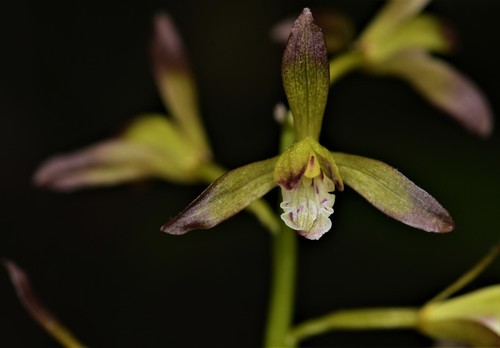
Aplectrum hyemale (Muhl. ex Willd.) Torr. is a species of orchid native to eastern Canada and the eastern United States. Its range extends from Oklahoma east to the Carolinas, and north to Minnesota, Ontario, Quebec, and Massachusetts. It is especially common in the Appalachian Mountains, the Great Lakes Region, and the Ohio and Upper Mississippi Valleys. Isolated populations have also been reported from Arizona. Aplectrum hyemale is the only species in the monotypic genus Aplectrum. The generic name derives from Greek, and means "spurless". This species is commonly called Adam and Eve or putty root. The common name putty root refers to the mucilaginous fluid that can be extracted from its tubers when crushed, which was used by Native Americans to mend pottery. Aplectrum hyemale spreads underground via the growth of its tubers, and forms large colonies. Its leaves emerge in late November and remain until March. The leaves are uniquely pin-striped, with parallel alternating silvery-white and green stripes. In late May or early June, a flower stalk grows up and bears several small flowers, each only a few millimeters across. Aplectrum hyemale is sometimes confused with Tipularia discolor, another orchid species found in eastern North America. A color variant, Aplectrum hyemale var. pallidum, exists and differs from the main species in its flower color. Little is known about the pollination biology of Aplectrum hyemale. It flowers in late spring, and its flowers do not produce nectar, so they attract very few pollinators. Documented floral visitors include the bees Bombus separatus and Bombus americanorum. Because Aplectrum hyemale attracts so few pollinators, it relies on autogamy, or self-pollination, to reproduce.