About Apis florea Fabricius, 1787
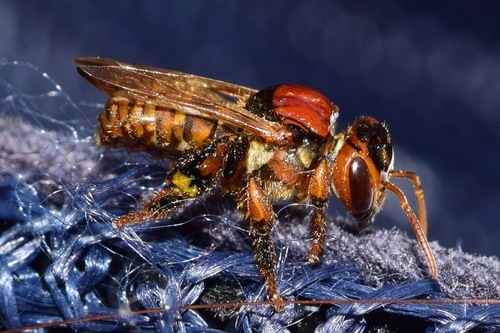
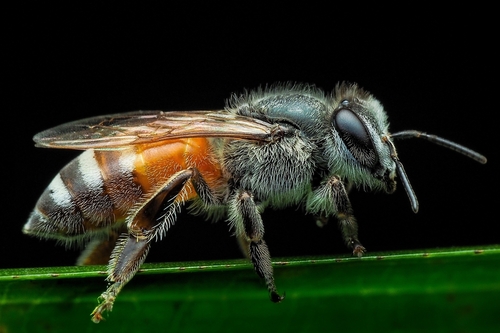
Apis florea Fabricius, 1787, commonly called the dwarf honey bee, is named for its small size relative to other honey bees. Worker individuals typically have a body length of 7–10 mm and an overall red-brown coloration. Old workers always have a red first abdominal segment, while younger workers are paler in color. Drones have a thumb-like bifurcation called the basitarsus, located two-thirds along the length of the tibia. The fimbriate lobe of A. florea has three protrusions, and the species stings using two stylet barbs. Along with its sister species A. andreniformis, A. florea makes up the subgenus Micrapis, the most primitive group of living Apis species. This primitivity is reflected in the species' small colony size and simple nest construction: colonies build a single, exposed comb that is almost always attached to a single branch of a tree or shrub. If a new nest is built close to an old nest, the colony salvages wax from the old nest to reuse. This wax recycling behavior only occurs in colonies that migrate less than 200 meters; colonies migrating longer distances do not perform this behavior, and no other honey bee species exhibits this behavior. Unlike domesticated Apis mellifera and other honey bees, forager A. florea do not perform gravity-oriented waggle dances on the vertical comb face to recruit nestmates. Instead, they perform the dance on the horizontal upper surface where the comb wraps around the supporting branch, with a straight run that points directly to the pollen or nectar source the forager has visited. The distinct status of A. florea and A. andreniformis as separate species was confirmed unequivocally in the 1990s. A. florea is redder than A. andreniformis, which is generally darker and has a completely black first abdominal segment in old individuals. A. florea is native to parts of Asia and Africa, and is most commonly found in southeastern Asia including Thailand, India, Myanmar, Cambodia, Vietnam, parts of China, as well as forested regions of the Middle East including Iran, Oman, and the United Arab Emirates. It has been present in Sudan since 1985, and in 2024, a fully established colony was recorded for the first time in Europe, in Malta. This species inhabits forest habitats, and also acts as a pollinator for tropical fruit crops in Thailand. When selecting a new nesting site, A. florea workers reach a collective decision through dancing: the site selected is the one that receives dancing from the largest number of individuals. Workers produce an auditory piping signal to indicate that a decision has been reached. After the signal, the top of the swarm lifts into the air first, followed by the bottom, then the middle, all within one minute of the initial lift off. Unlike A. mellifera, A. florea does not have multiple workers re-evaluate a site before the entire swarm moves to it. Instead, the entire swarm travels to the new site as a group, and leaves for a different site if the selected site is later found to be unsuitable. This makes the nest site search process much faster for A. florea than for A. mellifera, though it is not necessarily more accurate. Since nest site selection via dancing is shared by A. florea and A. mellifera, this behavior is thought to have evolved in the common ancestor of the genus Apis. Aside from small body size, simple exposed nests, and simplified dance language, the lifecycle and behavior of A. florea is fairly similar to other Apis species. Like A. mellifera workers, A. florea workers engage in worker policing, a process where non-queen-laid eggs are removed from the hive. Queenless A. florea colonies have been observed to merge with nearby queen-right A. florea colonies, which suggests that workers are attracted to queen bee pheromones. Human harvest and consume honey produced by A. florea in parts of the species' range. As excellent pollinators, A. florea fills an important ecological role in the areas it inhabits.