About Apis andreniformis Smith, 1857
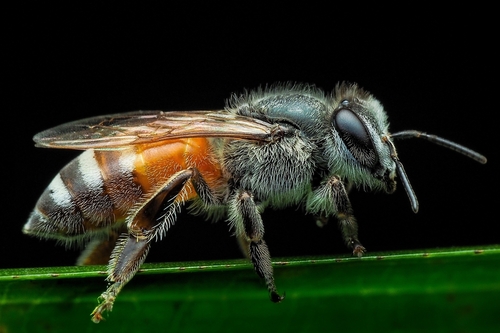
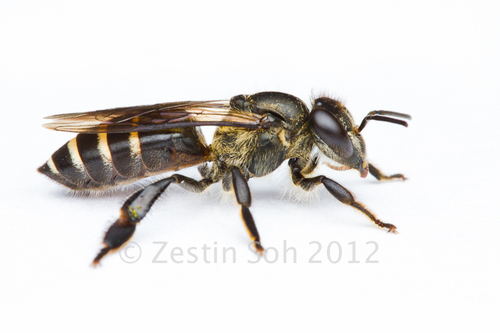
Apis andreniformis Smith, 1857 is the darkest species in the genus Apis, distinguished by its overall dark black coloration. Originally classified as part of Apis florea, recent morphological studies have confirmed it is a separate species. Key structural differences between A. andreniformis and A. florea include differences in endophallus structure, larger wing venation in A. andreniformis, and a longer basitarsal extension in A. florea. There are also subtle consistent color differences between the two species, although color alone is not a fully reliable identifier. Most A. andreniformis individuals have black first two abdominal segments and a reddish brown scutellum, while most A. florea have reddish brown first two abdominal segments and a black scutellum. A. andreniformis also has black hairs on its tibia, while A. florea has white hairs in this location. Further distinguishing traits are cubital index and proboscis length: A. andreniformis has a cubital index of 6.37 and a proboscis length of 2.80 mm, compared to 2.86 and 3.27 mm for A. florea. Within the A. andreniformis species, queens can be told apart from workers and drones by their nearly all-black coloration. A. andreniformis is distributed in southeast Asia, with confirmed populations in southern China, India, Burma, Laos, Vietnam, Thailand, Malaysia, Indonesia, and the Philippines. It commonly occurs in sympatric distribution with A. florea, but it is rare to find nests of the two species on the same tree or bush, and individuals of each species nest closer to other members of their own species than to the sister species. A. andreniformis is classified as a lowland species because it is most often found at elevations below 1,000 m, though it may migrate to higher elevations during rainy seasons. It occurs only in tropical and subtropical regions, while cavity-dwelling honey bee species occupy colder climates.