About Apiosporina morbosa (Schwein.) Arx
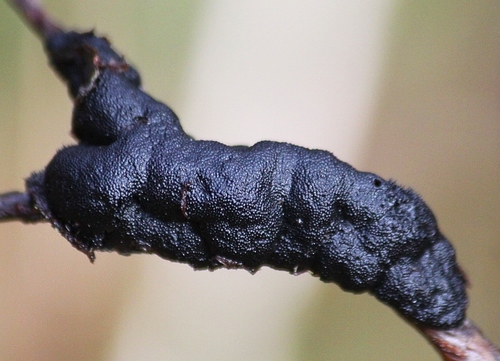
Apiosporina morbosa (also known under the synonym Dibotryon morbosum) is a plant pathogen that causes the plant disease black knot. It infects trees of the Prunus genus, including cherry, plum, apricot, and chokecherry trees across North America. Black knot produces rough, black growths called knots that encircle and kill infested tree parts, and these growths also provide habitat for insects. This pathogen was first formally described in 1821 in Pennsylvania, and has since spread across the whole of North America. In the late 19th century, it was one of the most destructive diseases affecting plum and cherry trees. Today, the disease is relatively well controlled in most cultivated areas, and is primarily found in poorly managed orchards or in locations where it is already strongly established, including wild habitats. Many urban centers across North America run active black knot control programs. Black knot only develops on the woody parts of host trees, most often on twigs and branches, but it can spread to larger limbs and even the tree trunk. Olive-green swellings caused by the disease become visible in late spring. As the disease spreads and the pathogen matures, which typically occurs by autumn, rough black knots form around affected tree parts and kill them. Knots range in diameter from 2.5 cm (1 inch) to 30 cm (1 foot). Older established knots can kill the entire host tree by encouraging harmful insect infestations. The most common management approaches for black knot are pruning out infected tree parts during winter and spraying new buds with a fungicide. Nearby wild Prunus plants infected with the pathogen must also be treated to stop spread. The fungus overwinters inside existing knots, and releases ascospores the following spring. Spores are released during wet spring weather; wind and rain carry spores to new susceptible locations, where they infect young saplings or wounded tree branches. The fungus grows and spreads best in warm, wet spring conditions, with temperatures between 60 and 80 degrees Fahrenheit being ideal for spore dissemination, germination, and infection of new plant tissue. Rainfall plays a key role in the disease cycle: it triggers spore release, allowing new infection events to begin, and rain splash helps move ascospores along with air currents to new host tissue.