About Apioperdon pyriforme (Schaeff.) Vizzini
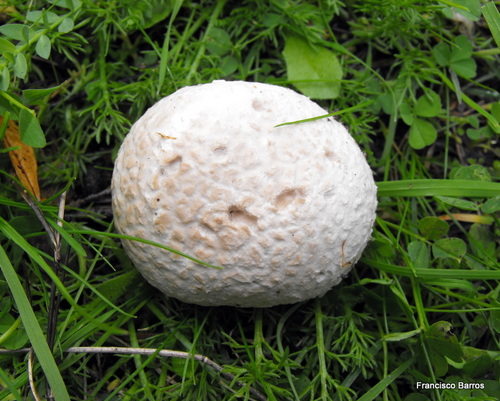
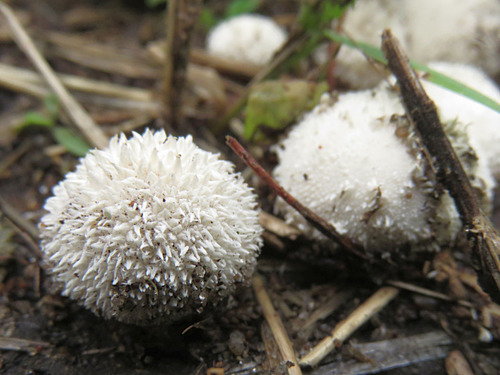
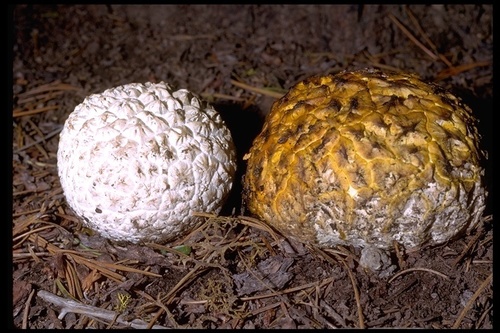
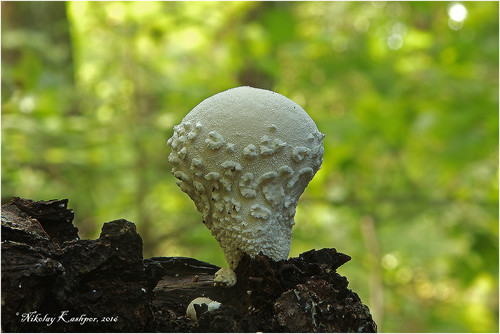
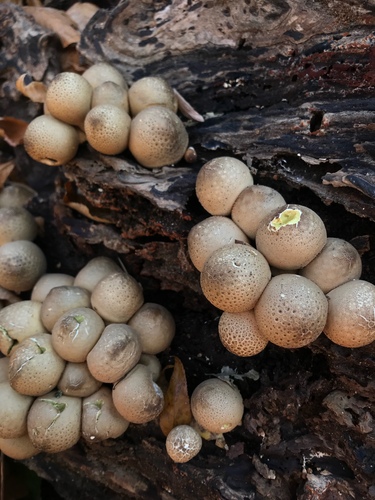
Apioperdon pyriforme, commonly known as the pear-shaped puffball, produces fruit bodies that reach up to 3 centimetres (1+1⁄4 inches) wide and 6 centimetres (2+1⁄4 inches) tall. As their common name suggests, fruit bodies are most often pear-shaped, but they may also be nearly spherical. Very young fruit bodies are covered in small white spines, which typically fall off before the mushroom reaches maturity. A small developing pore can usually be seen at the top of the fruit body, and the mushroom’s small sterile base has a pinched appearance. The colour of the fruit body ranges from nearly white to yellowish brown, with darker tones developing as the mushroom ages; the base of the fruit body stays white even as the rest darkens. At late maturity, the central pore ruptures to allow wind and rain to disperse the mushroom’s spores. The fruit body anchors to wood through rhizomorphs, which are thick, cord-like strands of mycelium. The gleba—the inner spore mass inside the fruit body—is white when young, and turns from greenish-yellow to dark olive-brown as it ages. The spores of this species are between 3 and 4.5 micrometres across, round in shape, smooth-surfaced, and dark olive-brown in colour. In terms of distribution and habitat, this species can be found growing on decaying wood all across Europe from July through December. In western North America, it appears during the fall and winter seasons.