About Apina callisto (Angas, 1847)
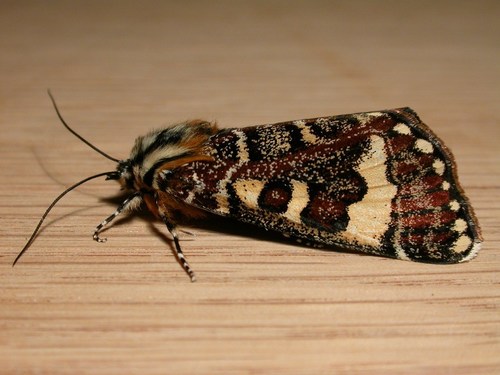
The pasture day moth, Apina callisto, is a moth species belonging to the family Noctuidae. As its common name suggests, it is active during the day, which sets it apart from most other noctuid moth species. This species occurs across most southern regions of Australia, spanning from southern Queensland to Tasmania. It was first formally described by George French Angas in 1847. Apina callisto is the sole species in the monotypic genus Apina, a genus that was established by Francis Walker in 1855. Female pasture day moths lay their eggs in pastures. The eggs hatch after heavy rains occur in early spring. Once larvae reach full maturity, they measure about 60 mm (2.4 in) long, then burrow into the ground to develop into pupae. Fully grown larvae have striking coloration: two yellow stripes run along their mottled black backs, with blue spots spaced between the stripes. Their entire bodies are covered in white spines. The larvae feed on a variety of broad-leaved plants. The adult moth has black wings marked with cream and chestnut patterns, and a wingspan of around 50 mm (2.0 in). Its thorax is black, and its abdomen is orange with black ring markings. Recorded food plants for the pasture day moth include: Arctotheca (capeweed), Erodium (storksbill), Lepidium, Malva (mallow), Modiola (bristle mallow), Plantago (plantain), Poaceae (grasses, including Paspalum), Rumex, Salvia (sage), Sonchus (sow-thistle), and Trifolium (clover).