About Aphyllon ludovicianum (Nutt.) A.Gray
Aphyllon ludovicianum, also widely known under the synonym Orobanche ludoviciana, is commonly called Louisiana broomrape or prairie broom-rape. It is a flowering plant species belonging to the family Orobanchaceae. Thomas Nuttall first formally described this species in 1818.
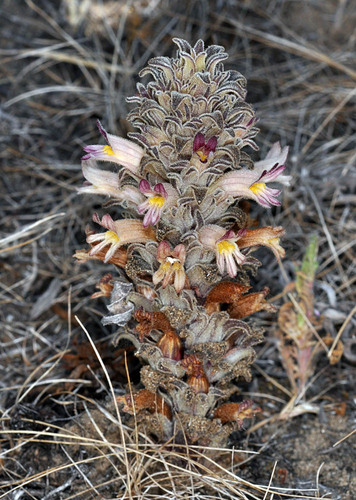
This plant is parasitic; it obtains nutrients from neighboring plants through its roots. Common host species for this parasite include gumweed and wormwoods, and it may also parasitize other members of the plant family Asteraceae. Mature plants grow between 1 and 3 decimeters tall, and most often do not produce branches. Its leaves are reduced to numerous small scales.
The plant produces many-flowered spike-shaped inflorescences, which make up between one third and one half of the total length of the above-ground shoot. Flowers are either sessile, or the lower flowers on a spike have short pedicels that reach up to 15 millimeters in length. The calyx is subtended by 1 or 2 bracts, and the calyx structure is bilabiate. The corolla measures between 1.5 and 2.5 centimeters in length, and is typically colored a violet-like shade. The chromosome counts recorded for this species are 2n = 24, 48, 72, and 96.
Aphyllon ludovicianum typically grows in sandy soil. Its native range extends across the central plains of North America, and extends northwest into British Columbia and Oregon. This species can be found in flower from June through August.