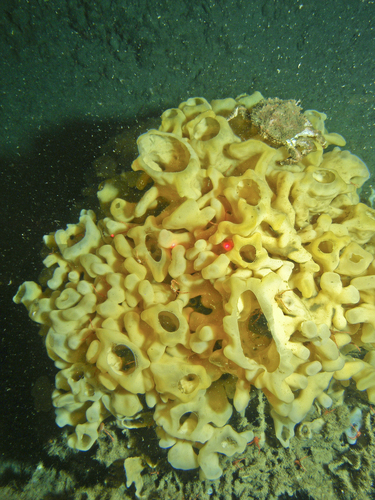
About Aphrocallistes vastus Schulze, 1886
Aphrocallistes vastus Schulze, 1886 is commonly known as the cloud sponge, and a morphologically variant form is called the quesadilla sponge. This sponge typically grows into a large cup shape with an irregularly folded wall that is around 5 millimetres (0.20 in) thick. The wall is pierced by many pores about 1 millimetre (0.039 in) wide, and covered by a thin dermal membrane. The sponge’s skeletal elements form a lattice structure built from fused silica spicules. These spicules mesh together and project into adjacent canals. A fir-tree-like concentration of spicules runs through the body wall, with branches that have either rounded or knobbly ends. The overall form of the cloud sponge changes based on the location it inhabits. The common name 'quesadilla sponge' refers to a morphological variation of this species that was first documented in Olympic Coast National Marine Sanctuary. Cloud sponges may grow into a mitten-like shape, or be tall and cylindrical or bowl-like; in areas with strong currents, they instead grow dense and compact. The cloud sponge is distributed across the northern Pacific Ocean, with a range that includes Japan, Siberia, the Aleutian Islands, and the west coast of North America from Alaska south to California and Mexico. It is a deep-water reef-building species that grows on sediment-free rocks on the western Canadian shelf. It can also be found growing at depths as shallow as 25 metres (82 ft) in fiords off the coast of British Columbia, where it is easier to study. The cloud sponge is one of several glass sponge species that form slow-growing reefs in deep water. The skeletons of these sponges create habitat for diverse communities of invertebrates and fish. Over 90% of the cloud sponge’s body is made of biogenic silica, which has no nutritional value. Despite this, two species of dorid nudibranchs, Diaulula lentiginosa and Doris odhneri, have been observed feeding heavily on cloud sponge. The cloud sponge is fragile, with a texture similar to dry toast. It has a very slow growth rate: juveniles take ten to twenty years to reach moderate adult size. It is easily damaged by seabed trawling, and severe trauma appears to kill it, though it can repair small injuries.

