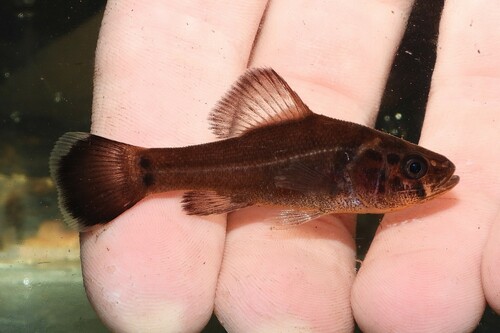
About Aphredoderus sayanus (Gilliams, 1824)
This species is the pirate perch, with the scientific name Aphredoderus sayanus (Gilliams, 1824).
Description: This small fish reaches a maximum total length of 14 cm (5.5 in). It is dark brown, and sometimes has a darker band near the base of the tail. In young individuals, the anus is located between the pelvic fins. As the fish grows, the anus migrates forward, and eventually settles in the throat region. Pirate perch may be the only known animal that exhibits generalized chemical camouflage (crypsis) that is effective across a wide number of potential prey species.
Distribution: The pirate perch is a freshwater species that lives in temperate climates, where water temperatures generally range from 5 to 26 °C (41–79 °F). It is most commonly found in central and eastern North America. It occurs in rivers of the Atlantic and Gulf slopes, the Mississippi Valley, and scattered parts of the eastern Great Lakes Basin. The subspecies A. s. gibbosus occurs west of the Eastern Continental Divide, and in the Gulf of Mexico basin west of the Mississippi River. The nominate subspecies occurs along most of the Atlantic coast north of the Florida–Georgia border. Intergrades between the two subspecies are found from Florida to Mississippi. According to the Nature Conservancy, pirate perch once occurred in Pennsylvania's Delaware River drainage, but are now likely extirpated there. The species may also be extirpated in Ohio. Its geographic range is very limited in the United States. Dam construction and growing impacts of urbanization are reducing the total available habitat for this fish, which could eventually lead to extirpation of the species in additional areas.
Ecology: These fish inhabit densely vegetated areas, locations with woody debris, and areas under banks within root masses. This species uses deep water debris associated with undercut banks and slow inside flows more often than other habitats. Habitat use depends on fish size: medium to large pirate perch occupy more structurally complex locations than small individuals. They congregate in these areas to avoid predation by piscivorous birds, otters, and mink. Pirate perch feed nocturnally. Their diet consists of live mosquito larvae, amphipods, glass shrimp, meal worms, small fish, dragonfly larvae, stonefly larvae, and earthworms.

