About Aphrastura spinicauda (Gmelin, 1789)
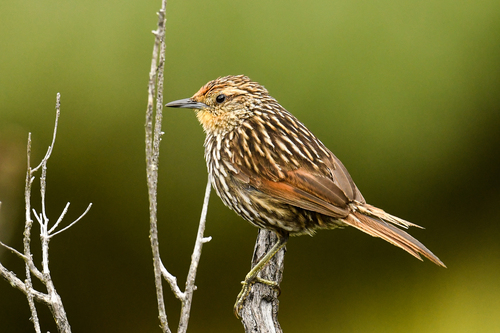
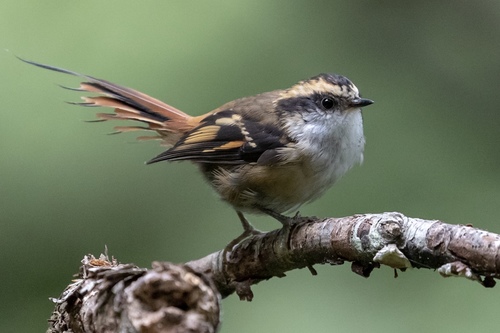
The thorn-tailed rayadito, scientifically named Aphrastura spinicauda (Gmelin, 1789), measures approximately 14 centimetres (5.5 in) in total length including the tail. Adult individuals have an average weight of around 11 grams (0.39 oz), with males roughly 10 percent heavier than females. This species is often compared to tits, and its most distinctive feature is its long "thorn"-shaped tail, which holds twelve spiny rectrices. This tail structure develops gradually as juvenile birds mature. Unlike in related funariids such as tit-spinetails, this thorn-tail is not thought to help with climbing trees; instead, it is believed to function in attracting mates during courtship. In the nominate subspecies Aphrastura spinicauda spinicauda, the plumage is brown with several black markings on the upper body, and generally white on the underparts. The subspecies Aphrastura spinicauda fulva found on Chiloé has a cinnamon throat rather than a white one, while the Mocha Island subspecies Aphrastura spinicauda bullocki has an entirely brown dorsal side with no black lines, and retains a white throat. The thorn-tailed rayadito has four distinct typical vocalizations: a loud trill, an alarm call described as a scolding "tsii...tsii...tsii", a softer repetitive trill "trrrrrreet", and a chorus call used during the nonbreeding season. This bird occurs in noisy flocks ranging from central Chile and adjacent Argentina, south to Tierra del Fuego. Research into glacial refugia used by the species when the Patagonian Ice Sheet covered most of its current range found that Mocha Island was the most prominent glacial refuge. The study also suggests the species may have occupied areas east of the ice sheet in Argentine Patagonia, which allowed for substantial gene flow once most of the ice sheet melted. Like most furnariids, the thorn-tailed rayadito feeds exclusively on insects. Similar to northern hemisphere tits, it searches the surfaces of bark and moss to find small insects. During the non-breeding season, which runs from March to September, it forms large mixed-species flocks with other Furnariidae species. However, thorn-tailed rayaditos are typically so numerous that they outnumber all other flock species combined, and in almost half of all observed flocks, rayaditos are the only species present. When other species do join the flocks, common companions include white-throated treerunners, striped woodpeckers, and fire-eyed diucons. During the non-breeding season, rayaditos usually form conspecific flocks of four to seven individuals. During the breeding season from October to February, paired rayaditos are strongly territorial. They are highly curious, fearless birds, and behave inquisitively when humans enter their forest habitat. The species adapts well to a broad range of forest types across its range. It occurs in tall Nothofagus and Araucaria forests in the northern part of its range, low subantarctic forests in the far south, and relatively dry Austrocedrus forests in the eastern part of its range. Thorn-tailed rayaditos do not range beyond these relatively dry cedar forests into the "scrub beech" areas further east. They generally require forest corridors of considerable size, though the required size is smaller than that needed by many other endemic Patagonian forest birds.