About Aphis lugentis Williams, 1911
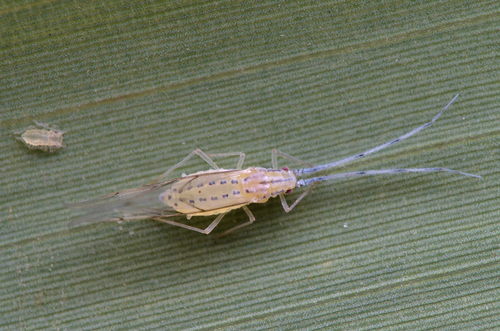
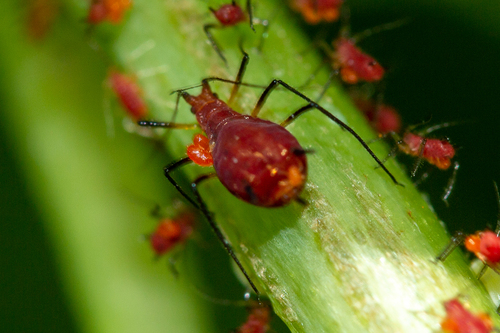
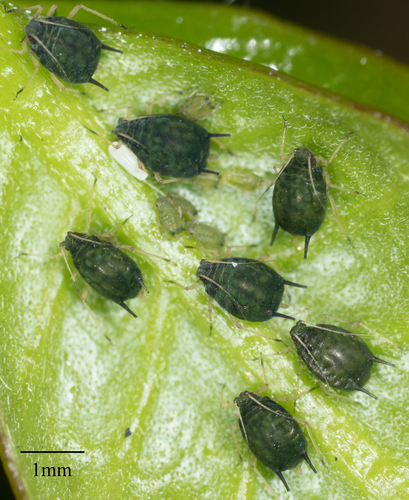
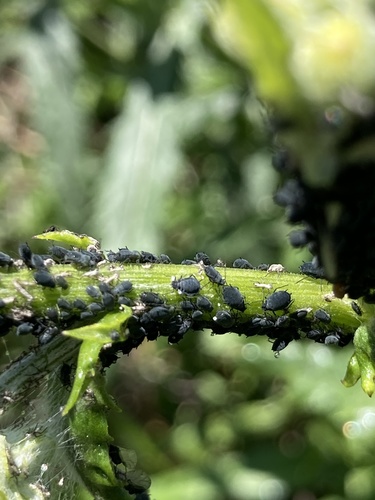
Scientific name: Aphis lugentis Williams, 1911. Wingless (apterous) Aphis lugentis individuals range in colour from dark yellow-brown, to dark olive or matte black. This is a relatively large aphid species; apterous individuals have a body length between 1.9 and 2.8 millimeters. Unlike less gregarious species such as the sycamore aphid, Aphis lugentis forms dense, aggregated clusters of 50 to 200 individuals on their host plants. This species belongs to the 'fabae' clade within the subgenus Aphis, a group that contains dark-coloured aphids with very similar morphology. Aphis lugentis can be distinguished from its close relatives by three key traits: its uniformly black appendages (Aphis fabae has light-coloured tibiae), its larger apterous body size (Aphis senecionis has an apterous body length of 1.7–1.9 mm), and its oligophagous diet (Aphis jacobaeae has a specific host preference for Jacobaea vulgaris, synonym Senecio jacobaea). A. lugentis was first nominally described from specimens that were recorded as collected on Senecio lugens, but this is not the actual type host. The original specimens were actually collected from Senecio integerrimus var. integerrimus, which Williams misidentified as S. lugens. In its native range, Aphis lugentis occurs naturally across most of the United States; the American Northeast is the exception, where the species has been introduced. Across North America, the southern limit of its distribution reaches northern Mexico, and its northern limit reaches Canada. In New Zealand, Aphis lugentis occurs predominantly around the port cities of Auckland, Wellington, and Christchurch, with a northern distribution limit in Northland and a southern limit at Christchurch. It is likely that A. lugentis was introduced to New Zealand on ornamental Senecio species and agricultural produce. Additionally, winged (alate) A. lugentis individuals can potentially disperse via wind currents from Australia or other distant locations. Since Aphis lugentis cannot survive apart from its host plants, it prefers habitats where species of Senecio, Erigeron, or Packera grow prolifically. Recorded sightings of A. lugentis on S. madagascariensis in Northland are from often disturbed habitats such as roadsides and pastures. In Australia, observations of A. lugentis on Senecio odoratus were made in a frequently disturbed area on sandy soil. Aphis lugentis is monoecious, meaning it relies on a single or limited range of host plant taxa throughout its entire life cycle. This differs from the heteroecious life cycle of A. fabae, which overwinters on a second host plant family. For A. lugentis, acceptable hosts belong to a range of species in the tribe Senecioneae. Aphis lugentis is also holocyclic, meaning it produces sexual females (oviparae) and eggs every year. After winged (alate virginoparae) individuals land on a suitable host, they give birth to wingless (apterous virginoparae) females. These apterous individuals reproduce asexually through parthenogenesis: a female aptera gives birth to a clone that is already pregnant with its own offspring, a structure similar to a matryoshka doll. This process is called "telescoping of generations" and allows rapid colonization of the initial host plant. In autumn, as herbaceous plant growth declines, apterous females begin to give birth to winged females and males (alatae) capable of sexual reproduction (gynoparae). Mating between these sexual aphids produces eggs that can overwinter on either a primary or secondary host. In the Northern Hemisphere, alate males and oviparae of A. lugentis can be found in October.