About Aphis gossypii Glover, 1877
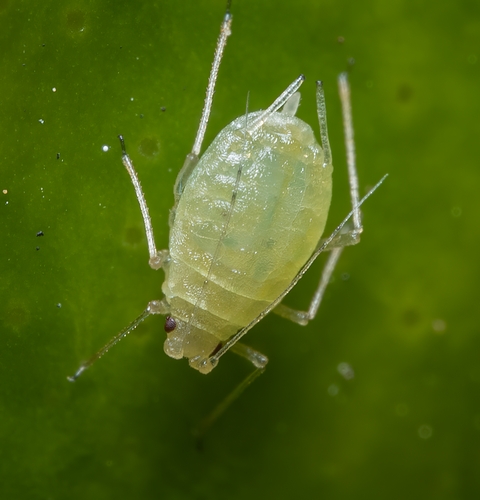
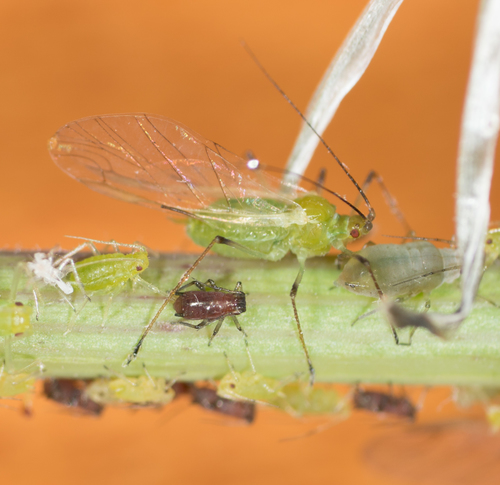
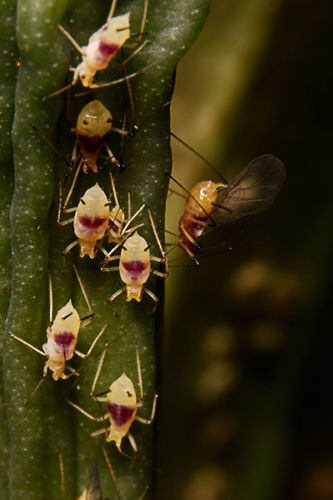
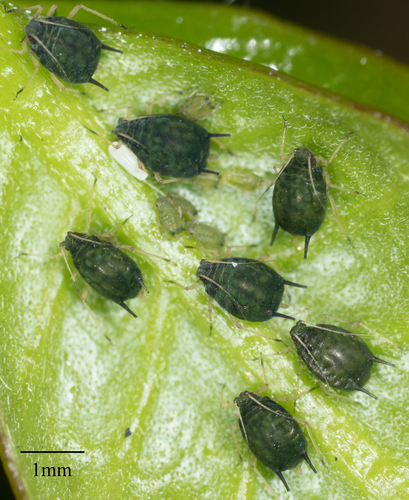
Morphology: The wingless (apterous) female cotton aphid, Aphis gossypii, has an ovoid body about 2 millimetres long, and occurs in varying shades of green. Its legs and antennae are yellow; antennae measure three-quarters of the body length, while the apices of the femora, tibia, and tarsi are black. The aphid has cylindrical black siphunculi that are wide at the base and one fifth the length of the body. The winged female has a fusiform body, with a black head and thorax, yellowish-green abdomen marked with black lateral spots, and antennae that are longer than those of the apterous female. Nymphs vary in colour, occurring in shades of green, tan, and gray. They often have a dark head, thorax, and wing pads, and the distal portion of the abdomen is usually dark green. Their bodies appear dull because they are dusted with wax secretions. Newly laid eggs are oval and yellow, but quickly turn glossy black. In the southern half of the United States, extending as far north as Arkansas, sexual reproduction is not important for this species. Females continue to produce offspring without mating as long as weather conditions are favourable for feeding and growth. Further north, cotton aphids can be holocyclic, with a life cycle that involves two host species; a broadleaved tree such as Catalpa, Rhamnus, or Hibiscus acts as the primary host. In Europe, this aphid reproduces exclusively by asexual reproduction, and can produce nearly fifty generations a year under favourable conditions. In Russia, various wild plants host the overwintering eggs of the species. Winged forms then migrate to secondary host species in the families Rosaceae, Chenopodiaceae, Malvaceae, Cruciferae, Cucurbitaceae, Solanaceae, Compositae, and other families. Parthenogenesis on these secondary hosts allows large aphid populations to build up quickly. A parthenogenic female has a life span of about twenty days, during which it can produce up to 85 nymphs. Nymphs mature in about twenty days at 10 °C, and in about four days at 30 °C. As autumn approaches, winged forms migrate back to the primary hosts. At this location, both males and sexual females are produced, mating occurs, and females lay eggs that overwinter to repeat the life cycle the next year. Predators of Aphis gossypii include midges, lacewings, syrphid fly larvae, anthocorid bugs, and ladybirds (ladybeetles). Several wasp species in the Aphidiinae and Aphelinidae families are parasitoids of this aphid; Aphelinus asychis is one species that shows promise as a biological control agent. Distribution: The origin of Aphis gossypii is unknown, but it is now found in tropical and temperate regions worldwide, except for extreme northern areas. It is common in North and South America, Central Asia, Africa, Australia, Brazil, the East Indies, Mexico, Hawaii, and most of Europe. It is cosmopolitan in habitat. It thrives outdoors in southern Europe, but only survives under glass in northern Europe. In the former Soviet Union, it occurs up to 54°N.