About Aphis fabae Scopoli, 1763
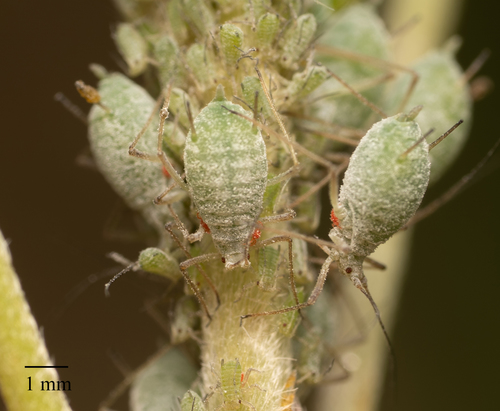
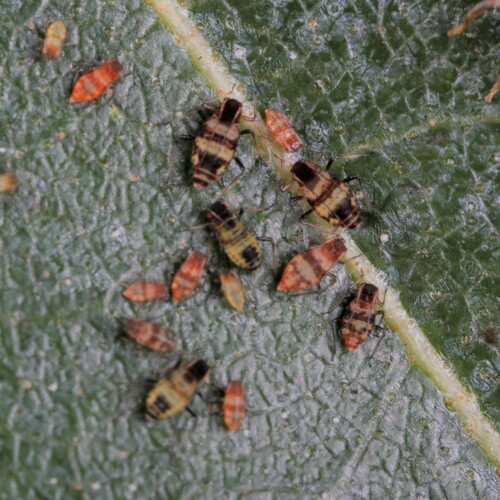
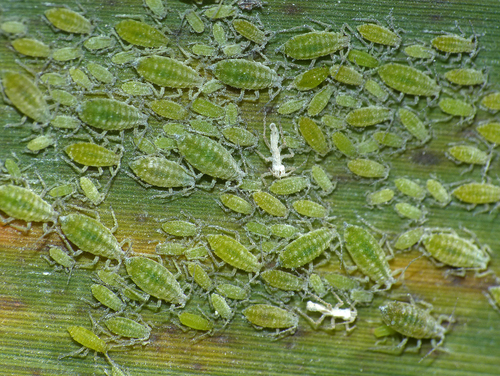
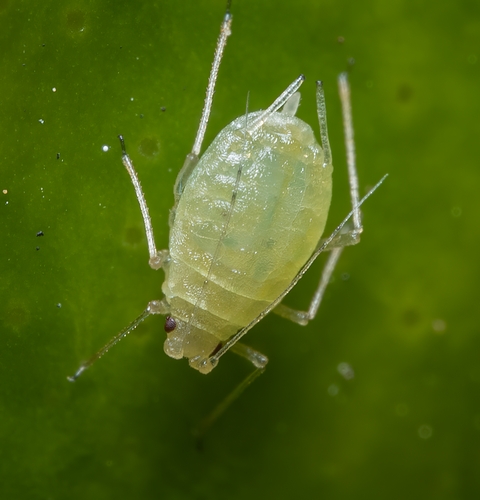
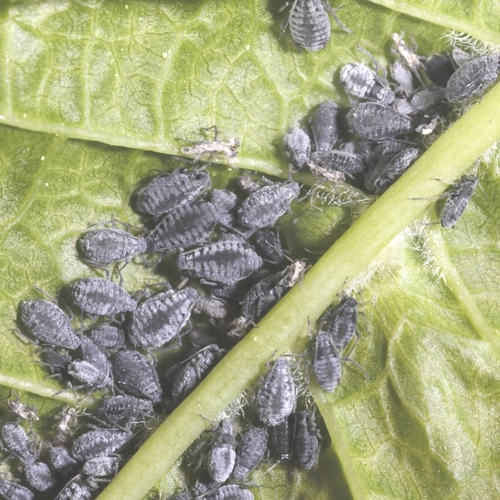
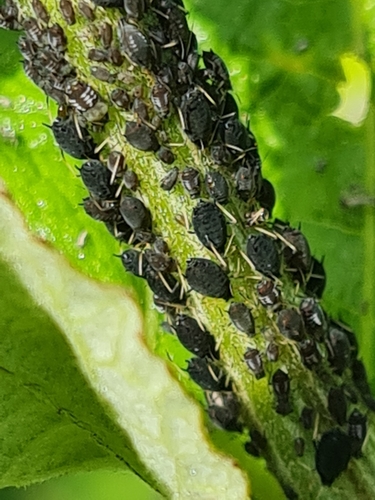
Aphis fabae Scopoli, 1763, commonly called the black bean aphid, is a small soft-bodied insect, meaning the exocuticle layer of its exoskeleton is greatly reduced. It has specialized piercing and sucking mouthparts that it uses to suck sap from plants. This aphid typically occurs in large groups. It is a tiny, plump insect around two millimeters long, with a small head and a bulbous abdomen. Its body is blackish or dark green in color. Most adult black bean aphids are wingless, a condition called aptery. Winged individuals, called alates, are longer and more slender than wingless apterous forms; they have shiny black heads and thoraxes. The membranous wings of alates are held at an angle over the body. The antennae are less than two-thirds the length of the body. Both the antennae and legs are pale yellow with black tips. The hind tibiae are swollen in egg-laying females. Near the back of the abdomen is a pair of slender, elongated tubes called cornicles or siphunculi. These structures produce a defensive waxy secretion, and are twice as long as the finger-like tail located near them. Both the cornicles and the tail are brownish-black. Black bean aphids may have originated in Europe and Asia, but are now one of the most widely distributed aphid species. They are found throughout temperate regions of Western Europe, Asia, and North America, and in the cooler parts of Africa, the Middle East, and South America. In warmer parts of their range, wingless apterous individuals can survive the winter and continue reproducing asexually year-round. This species is known to be migratory. The black bean aphid has both sexual and asexual generations in its life cycle, and alternates between different host plants at different times of year. Primary host plants are woody shrubs. In autumn, winged females lay eggs on these shrubs, after which the adult aphids die, and the eggs overwinter. The aphids that hatch from these eggs in spring are wingless females called stem mothers. Stem mothers can reproduce asexually via parthenogenesis, giving birth to live nymph offspring. A parthenogenetic female has a lifespan of around 50 days, and can produce up to 30 young in this time. All initial offspring are also female and can reproduce without mating, but later generations are usually winged. These winged aphids migrate to secondary host plants, which are entirely different species, typically herbaceous plants with soft, young growth. Further asexual parthenogenesis occurs on these new hosts, on the undersides of leaves and at growing tips. All offspring produced at this time of year are female, and large aphid populations develop rapidly, with both winged and wingless forms produced throughout summer. Winged individuals develop in response to overcrowding, and disperse to new host plants and crops. By midsummer, populations of predators and parasites of the aphid have increased, and aphid populations stop growing. When autumn approaches, winged forms migrate back to the primary woody host plants. Here, both males and sexual females are produced parthenogenetically, mating occurs, and these sexual females lay eggs in crevices and under lichens to complete the life cycle. Each female can lay six to ten black eggs that can survive temperatures as low as −32 °C (−26 °F). More than 40% of eggs typically survive the winter, though some are eaten by birds or flower bugs, and others fail to hatch in spring. Natural predators of black bean aphids include adult and larval ladybirds, adult and larval lacewings, and hoverfly larvae. Certain species of tiny parasitic wasps lay their eggs inside aphids, and the developing wasp larvae consume the aphid host from the inside. Wasps of the genera Diaeretiella and Lysiphlebus follow this behavior, and can provide a degree of control over aphid populations. Ants climb the host plants to feed on the honeydew secreted by the aphids. Many ant species have evolved behaviors to protect and support aphid populations. For example, black garden ants (Lasius niger) remove predators such as ladybirds from the area around aphids, keeping their 'milk cows' safe. On a test plot of field beans (Vicia faba), plants without black bean aphids produced an average of 56 seeds per plant. Plants with aphids but no ants produced an average of 17 seeds per plant, while plants with both ants and aphids produced an average of only 8 seeds per plant.