About Aphis craccivora Koch, 1854
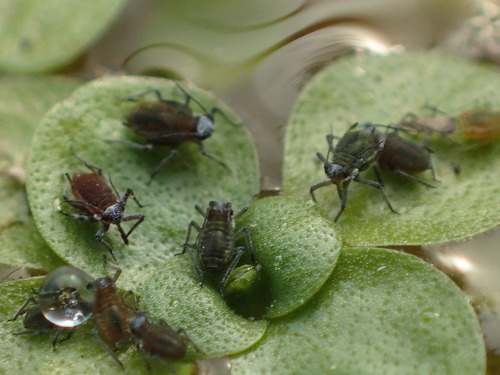
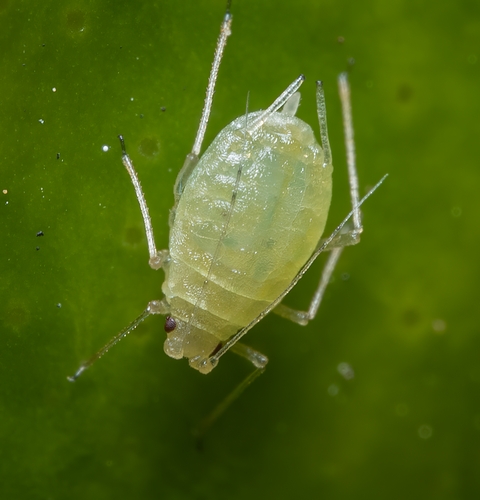
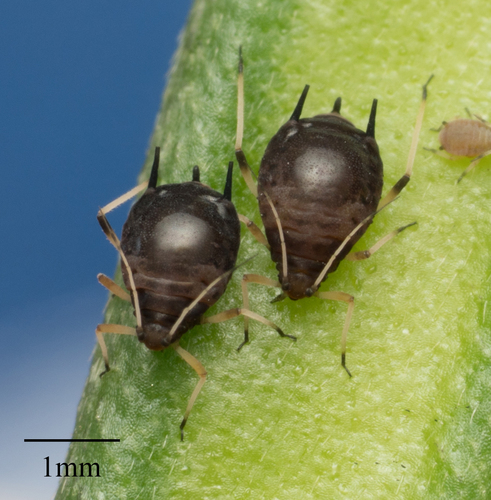
Aphis craccivora Koch, 1854 is a small species of aphid. Female individuals have a glossy black or dark brown body with a prominent cauda, a tail-like protrusion, and legs that range in shade from brown to yellow. Their antennae have six segments; the antennae, limb segments, cauda, and cornicles are pale close to the body and dark further away from the body. Adult Aphis craccivora do not have wax on their dorsal body surface, while nymphs are lightly dusted with wax. Winged females grow up to 2.2 mm (0.1 in) long and have cross-barring on the abdomen; wingless females are slightly smaller.
Aphis craccivora is thought to have originated in the Palearctic realm, but has expanded its range to become nearly cosmopolitan. In recent years, its range has extended further north into Siberia and Canada, and further south into Chile and Argentina. It is abundant in the Mediterranean region and subtropics, and is one of the most common aphid species in the tropics. It infests cowpea in India, the Philippines, Thailand, the southern United States, tropical Africa, and Latin America.
In the former USSR, Aphis craccivora overwinters as eggs, often at the base of young alfalfa plants, and has also been recorded overwintering on Acacia, camelthorn, and perennial weeds. Eggs hatch in early spring, and the first hatching larvae, called fundatrix or stem mothers, feed first on alfalfa. All of these early aphids are female, and reproduce via parthenogenesis, producing nymphs that moult four times over a period of eight to twelve days. By the end of April, winged females migrate to other host plants, often Acacia, and later to cotton, where this aphid pest causes considerable damage. It may move back to alfalfa later in the year. In Belarus, lupine is an important host plant for Aphis craccivora, while in Ukraine, Acacia is most affected. A female Aphis craccivora lives for 9 to 25 days and can produce 25 to 125 offspring during its lifetime. There may be up to twenty generations per year. By November, winged forms develop, and eggs are laid before winter begins. In warmer climates, parthenogenetic reproduction occurs year-round. Winged male Aphis craccivora are rarely encountered, but have been observed in Germany, India, and Argentina.
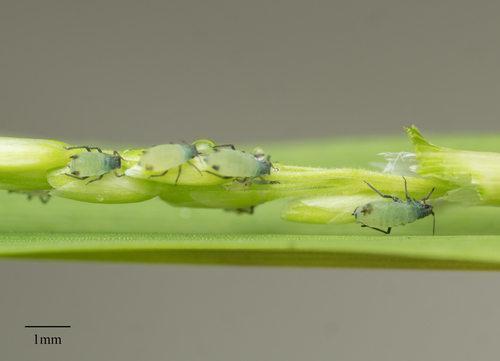
These aphids tend to concentrate on growing plant tips, young leaves, shoots, flowers, and developing seed pods. They are often tended by ants, which feed on the honeydew secretions they produce and deter the aphids' predators. Known natural enemies of Aphis craccivora include parasitic wasps, ladybirds, lacewing larvae, and hoverfly larvae.