About Apheloria virginiensis Drury, 1770
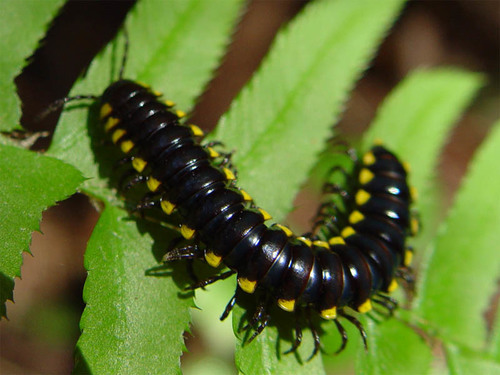
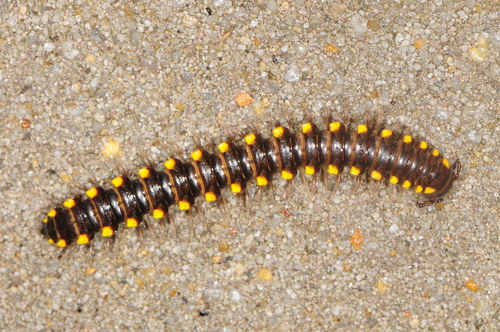
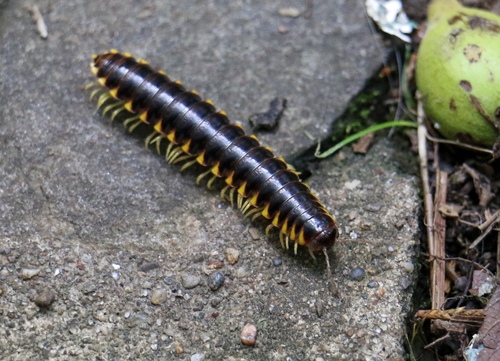
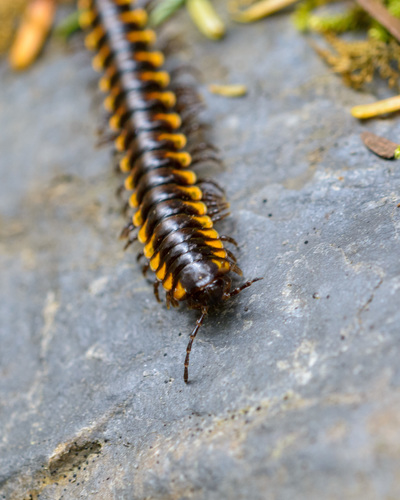
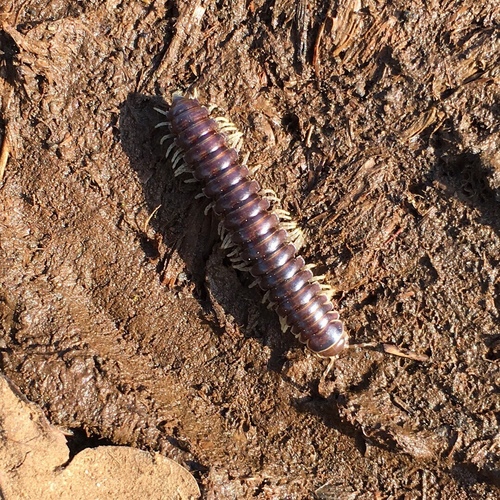
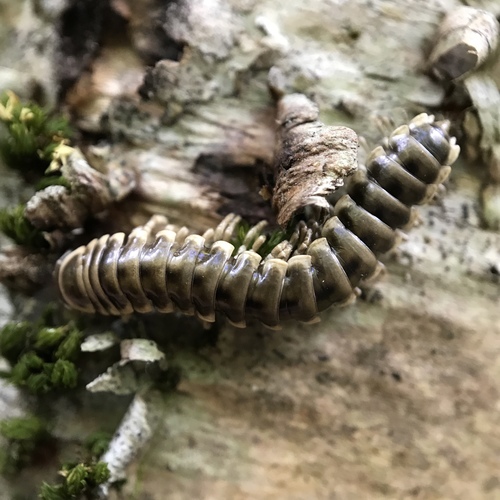
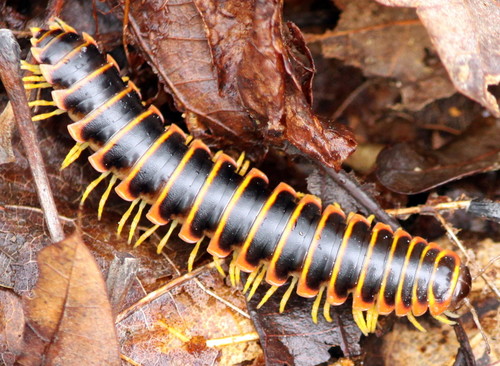
Apheloria virginiensis is a large millipede species, with adults ranging in length from 27 mm to 59 mm. It exhibits sexual size dimorphism, as females are typically larger than males. The species has a variety of color patterns; the most common pattern consists of a black dorsal surface, yellow spots on the paranota, and yellow legs. Another common three-spotted variation adds an extra spot in the middle of each metazonite and the collum. A different three-spotted pattern has pink paranotal spots, with yellow legs and yellow spots along the middle of the back. Less common variations include a two-spotted pattern with orange paranotal spots and orange legs, and a three-spotted pattern with all pink spots and pink legs. Like most species in the order Polydesmida, adult A. virginiensis have 20 body segments, counting the collum as the first segment and the telson as the last. As is typical for most polydesmid millipedes, adult females have 31 pairs of legs, while adult males have 30 pairs of legs. In adult males, the 8th leg pair is modified into a pair of gonopods. As with most Apheloria species, the distal part of each gonopod (called the acropodite) is uniformly narrow and curved into a circular shape, and the more proximal prefemur has a scythe-shaped projection. This species can be distinguished from other Apheloria species by specific gonopod features. For example, where A. virginiensis overlaps with A. corrugata in southern Virginia, the two can be confused in the field. A. corrugata has a smoothly circular acropodite, but A. virginiensis has a distinct elbow-like bend on its acropodite. This elbow also separates A. virginiensis from close relatives A. montana and A. polychroma, which both have smoothly circular acropodites. Additionally, A. virginiensis has a distinct tubercle at the junction of the acropodite and prefemur, while A. polychroma has an acute angle at this junction instead. Apheloria virginiensis occurs mainly in the piedmont and coastal plain of North Carolina, and its range also extends into southern Virginia. In North Carolina, it is often found in parks in the Research Triangle area, including William B. Umstead State Park. In Virginia, its range covers the Blue Ridge Mountains, piedmont, and coastal plain, reaching as far north as Hampden-Sydney College in Prince Edward County. The western extent of its range reaches the Blue Ridge Mountains in Floyd County, Virginia, and Wilkes County, North Carolina. This species is most often found in mesic habitats such as deciduous forests, and may also occur in mixed forests or sandy soil. It has been recorded living among pine, birch, beech, maple, oak, sweet gum, walnut, magnolia, hickory, rhododendron, tulip poplar, and cherry trees. It is typically found under decaying leaves or logs, often near streams and sandy woods, but can sometimes be seen walking on leaf litter or trails after dark. Adult A. virginiensis spend most of their time feeding on leaf litter and rotting wood from both coniferous and deciduous trees, while juveniles feed on humus. These millipedes digest dead leaves and excrete fecal pellets, contributing to the conversion of leaf litter into humus. For reproduction, female A. virginiensis lay their eggs in protected, moist locations that provide ready food for newly hatched young, most often under a log. After an incubation period of three or more weeks, pale juveniles hatch with fewer segments and legs than full adults. As juveniles grow, they molt repeatedly, darkening in color and developing brighter spots while adding new segments and legs with each molt until they reach full adult maturity. The total lifespan of this species is two to three years.