About Apheloria montana (Bollman, 1887)
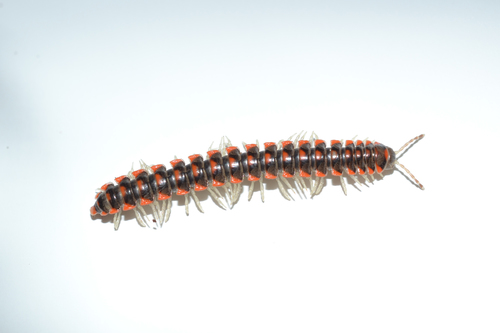
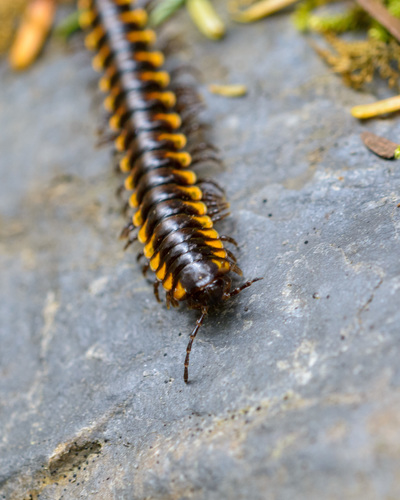
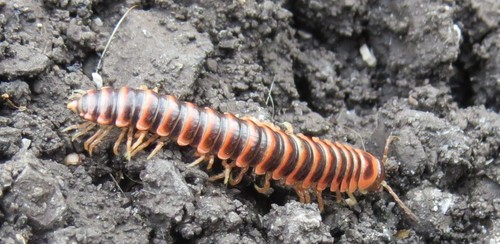
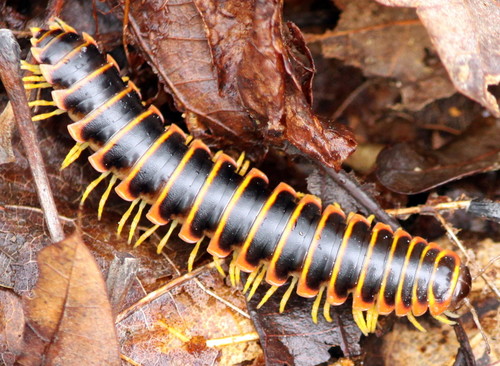
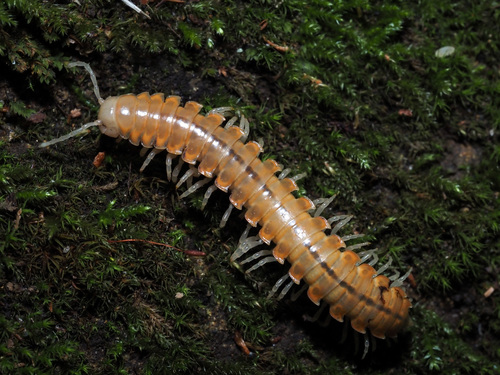
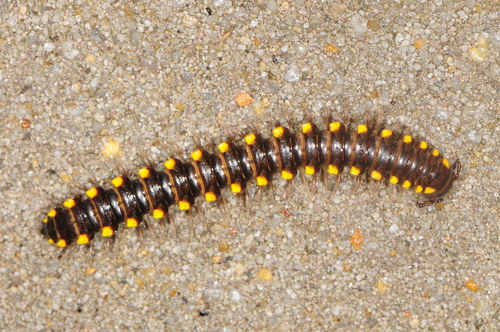
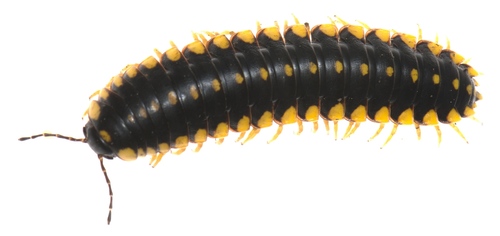
Apheloria montana is a large millipede species that reaches approximately 1 gram in weight, with adult body lengths ranging from 42 mm to 55 mm. This species shows sexual size dimorphism: females are generally larger than males. Most individuals have a black dorsal surface, yellow legs, yellow spots on the paranota, and an additional row of yellow spots running down the center of the back, with one spot on the middle of the collum and one spot on the middle of each metazonite. Populations in Little Switzerland, Mitchell County, North Carolina differ in having smaller orange spots and orange legs. Like most species in the order Polydesmida, adult Apheloria montana have 20 body segments when counting the collum as the first segment and the telson as the last segment. As is typical for most polydesmid species, adult females have 31 pairs of legs, while adult males have 30 leg pairs: males’ 8th leg pair is modified into a pair of gonopods instead of walking legs. Like most species in the genus Apheloria, the distal section of each male gonopod, called the acropodite, is uniformly narrow and curved into a circular shape, and the more proximal prefemur section has a scythe-shaped projection. Apheloria montana can be distinguished from other Apheloria species by specific gonopod features. It can easily be confused in the field with its closest relative A. polychroma, which also occurs in eastern Tennessee, but A. montana has a distinct tubercle at the junction of the acropodite and prefemur, while A. polychroma has an acute angle at this junction. A. montana can also be separated from its close relative A. virginiensis, which also occurs in North Carolina, by the shape of the acropodite: the acropodite forms a smooth circle in A. montana, but has a distinct elbow-like bend in A. virginiensis. Apheloria montana is distributed in eastern Tennessee and western North Carolina. In Tennessee, it has been recorded in Cocke, Greene, Unicoi, and Washington counties. In North Carolina, it is known from Buncombe, Madison, McDowell, and Mitchell counties. This millipede is most often found in mesic habitats such as deciduous forests, but it also occurs in drier habitats including mixed forests and rhododendron groves. It has been found in forest stands containing pine, maple, oak, beech, tulip poplar, witch hazel, alder, sweetgum, and buckeye. It typically lives under decaying leaf litter on the forest floor. Its diet consists of leaf litter, but the species also depends on coprophagy to survive. In a laboratory experiment, millipedes fed only leaf litter and deprived of their own feces became inactive and stopped producing new feces after 21 days, with some individuals losing weight or dying within a week. This evidence indicates that A. montana does not rely on internal symbionts to process leaf litter. Instead, it depends on bacterial activity in its fecal pellets to digest cellulose, and possibly to fix nitrogen.