About Aphelocoma wollweberi Kaup, 1855
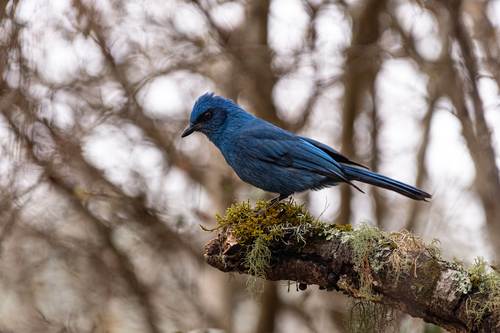
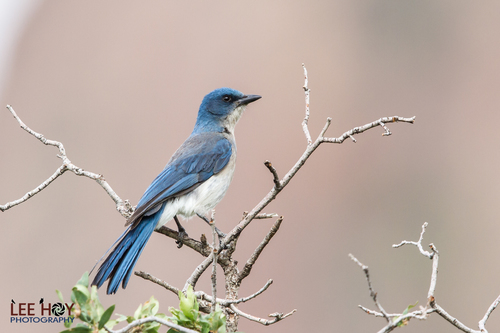
This species, the Mexican jay, is a medium-large passerine weighing approximately 120 grams, similar in size to most other jays. It has a blue head, blue-gray mantle, blue wings and tail, and pale gray breast and underparts. Males and females are morphologically identical. Juveniles differ from adults only in having less blue coloration; in some populations, juvenile bills are pink or pale instead of black, and progressively turn more black as the birds age. Some field guides incorrectly describe this pale bill as yellow, because the bill fades to yellow on preserved museum study skins. The Mexican jay has a brown iris and black legs. It can be most easily told apart from the similar Woodhouse's scrub-jay by its unstreaked plain throat and breast, and by the fact that its mantle contrasts less with its head and wings. The ranges of the Mexican jay and Woodhouse's scrub-jay overlap somewhat, and where the two species occur together, they show both ecological and morphological character displacement. The Mexican jay is native to the Sierra Madre Oriental, Sierra Madre Occidental, and Central Plateau of Mexico, as well as eastern Arizona, western New Mexico and western Texas in the United States. Its preferred habitat is montane pine-oak forest. In winter, the Mexican jay's diet consists mainly of acorns and pine nuts, which it stores during autumn. It is omnivorous year-round, however, and its diet includes a wide variety of both plant and animal matter: this includes invertebrates, small amphibians and reptiles, and birds' eggs and nestlings. The Mexican jay has a cooperative breeding system similar to that of the related Florida scrub-jay, where multiple birds help at a single nest. These "helpers" are usually immature offspring of the dominant breeding pair from the previous one to two years, but can also include apparently unrelated members of the flock.