About Aphelocoma coerulescens (Bosc, 1795)
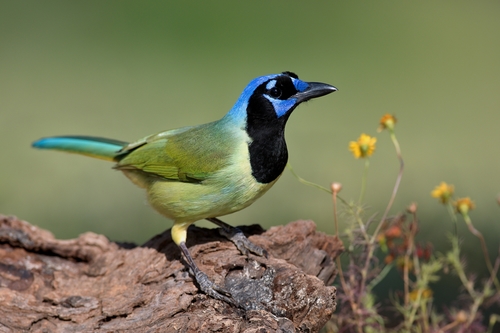
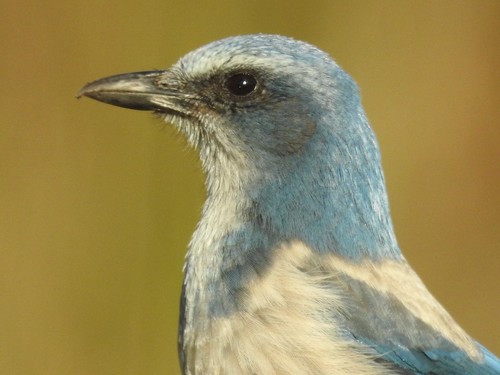
This species, the Florida scrub jay, measures 23 to 28 cm (9.1 to 11.0 in) in length, and weighs 66 to 92 g (2.3 to 3.2 oz), with an average weight of 80.2 g (2.83 oz). Its wingspan ranges from 33 to 36 cm (13 to 14 in). It has a strong black bill, a blue head and nape without a crest, a whitish forehead and supercilium, a blue bib, blue wings, grayish underparts, a gray back, a long blue tail, and black legs and feet. The Florida scrub jay is found only in Florida scrub habitat, an ecosystem that occurs only in central Florida and limited areas along Florida's Atlantic coast. This ecosystem is defined by nutrient-poor soil, occasional drought, and frequent wildfires. Between 34 and 28 million years ago, the area that now holds this habitat was isolated from the mainland as Orange Island. This long period of isolation, combined with a somewhat harsh weather pattern, led the habitat to evolve to host not just the Florida scrub jay, which is endemic only to Florida, but also a small set of very ancient specialized plant species, including sand pine, sand live oak, myrtle oak, Chapman's oak, sandhill oak, Florida rosemary, and various other hardy plants such as eastern prickly pear. Florida scrub jays are omnivorous. They eat a wide variety of food including acorns, seeds, peanuts, insects, tree frogs, turtles, snakes, lizards, and young mice. They have occasionally been observed eating other birds' eggs or nestlings, though this behavior is rare. Each year, they routinely cache thousands of acorns by burying them just beneath the soil surface. Acorns are typically buried in the fall and consumed during the winter and spring. Forgotten or unrecovered acorns may germinate, which makes the Florida scrub jay an effective agent for dispersing a variety of oak trees. The Florida scrub jay may carry out coordinated cooperative hunting. This has been documented in one case, where a mated pair of the birds was observed attacking a black racer together in southcentral Florida. The snake was likely too large for a single jay to kill alone, and the pair ultimately succeeded in killing the reptile. Cooperative hunting like this is rarely recorded in passerines. Scrub jays may also take silverware and other shiny objects, in a behavior similar to that of the American crow. Florida scrub jays are one of the few cooperative breeding bird species native to North America. Fledglings stay in their parents' habitat for several years, and help rear new young, watch for predators such as short-tailed hawks and Accipiter hawks, and defend territory against neighboring Florida scrub jay family groups. These family groups can range in size from 2 to 8 individuals. After 2 to 3 years, fledglings leave their birth group to form their own mating pairs. Mating season runs from March to June. Clutches usually contain 3 to 4 eggs, which are incubated for around 17 days. Fledging occurs around 16 to 19 days after hatching. Fledglings can be told apart from adult birds by the color of their head feathers, which are brown instead of blue. The brown feathers on a juvenile's head are slowly replaced by blue feathers as the bird matures into adulthood.