About Aphelocoma californica (Vigors, 1839)
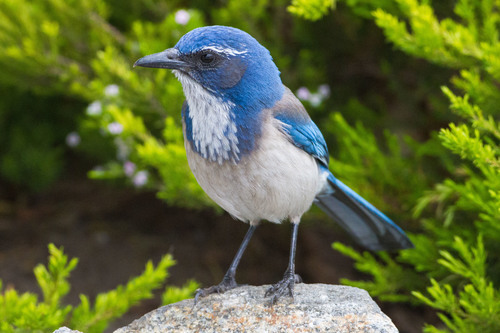
Aphelocoma californica, commonly called the California scrub jay, is a medium-sized bird. It measures approximately 27–31 cm (11–12 in) in total length including its tail, has a 39 cm (15 in) wingspan, and weighs about 80 g (2.8 oz). For its overall plumage, this species has blue feathers on its head, wings, and tail; a gray-brown back; grayish underparts; and white eyebrows. It has a whitish throat marked by a distinct blue necklace. Its call, or squawk, is described as harsh and angry-sounding. True to its common name, the California scrub jay lives in areas of low scrub. It prefers pinyon-juniper forests, oak woods, and the edges of mixed evergreen forests, and also lives in suburban gardens. Like many other corvids, California scrub jays exploit temporary food surpluses by storing food in scattered caches across their territories. They depend on highly accurate, complex memories to recover these hidden caches, often long after storing the food. When collecting and storing food, the species demonstrates an ability to plan ahead by choosing cache sites that will hold enough food volume and variety for future needs. Western scrub jays can also use their accurate observational spatial memories to steal food from caches created by other members of their own species. Food-storing California scrub jays use a range of strategies to protect their caches from potential pilferers. There is an anecdotal common belief that scrub jays, and corvids more broadly, are attracted to and will steal brightly colored objects, but recent research has debunked this idea, or at least casts significant doubt on it. Corvids do have a mischievous streak, however, and scrub jays will engage in outright theft. They have been observed stealing acorns from acorn woodpecker caches, and some scrub jays snatch acorns from the hiding places of other jays. When these birds go to hide their own acorns, they first check that no other jays are watching. Other cache protection methods include moving the cache when an observer is present, storing inedible decoys such as small stones instead of food, and hiding the cache only after a potential scavenging bird is no longer watching. These behaviors are thought to change based on whether potential pilferers (like other corvids) are present, as well as what type of animal might pilfer the cache, which suggests strategic and socially complex motivations behind different types of caching behavior.