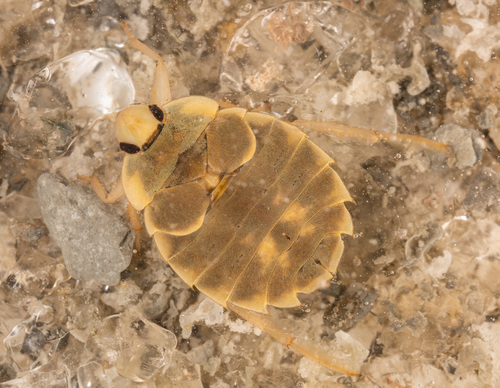
About Aphelocheirus aestivalis (Fabricius, 1794)
Aphelocheirus aestivalis (Fabricius, 1794) is a medium-sized aquatic bug, measuring 8.5–10 mm (0.33–0.39 in) in body length. Females of this species typically grow slightly larger than males. The body of A. aestivalis is flattened. The vast majority of individuals are rounded-bodied and have small, reduced wings; this non-flying form is called the micropterous morph. A rarer macropterous morph has a more elongated, ellipsoid body, with full-sized wings that allow it to fly. This species is mostly brown or greyish brown, with yellow colouration on the head, legs, and body edges, and blackish eyes. Entirely black individuals have been recorded, but this colour comes from a coating on the exoskeleton rather than internal pigment, and it is most common in older insects. Some individuals have dark colour patches on the head, or yellow markings or bands on the thorax and abdomen. The head is slightly longer than it is wide, and bears flattened, narrow eyes. The frons and clypeus, two hardened facial sections, form a rounded, cone-like shape that points toward the front of the insect. Both the scutellum and pronotum, two sections of the thorax, are short and wide; the pronotum has rounded lobes on the sides of its hind portion. The abdomen has a serrated outline, created by tergites that project from the sides of each abdominal segment. Each sternite on the underside of the abdomen has a slight protrusion, and these together form a small keel that runs down the center of the abdomen's underside. This species is widespread across much of Europe, extending into northeastern Africa and southwestern Asia. Its range stretches from the British Isles in the west to the Caucasus and Ural mountains in the east. In Africa, it is known to occur in Egypt, and its Asian range includes Turkey and Georgia. In Europe, it occurs from southern Scandinavia in the north down to the northern areas of the Mediterranean basin in the south. While older sources list the species as present on the Iberian Peninsula, these records are now thought to refer to the similar-looking Aphelocheirus occidentalis, and a 2011 study confirmed that A. aestivalis does not occur in this region. The flightless micropterous morph is found throughout the full range of A. aestivalis, while the flighted macropterous morph has only been recorded in parts of central and southern Europe. Within its range, this insect lives primarily in stony rivers with fast-flowing, oxygen-rich water, but also occurs in stagnant water sources including reservoirs and lakes. It is a benthic species, living near the bottom of water bodies between 0.4–9.0 m (1 ft 4 in – 29 ft 6 in) deep, where it is found under plants, rocks, or sediment. Though it is primarily a freshwater species, it can also live in brackish water; this is confirmed by 1898 records of specimens from the estuary of the River Seine, and 1943 records from the brackish parts of the Gulf of Finland and Randers Fjord.

