About Aphelocephala leucopsis (Gould, 1841)
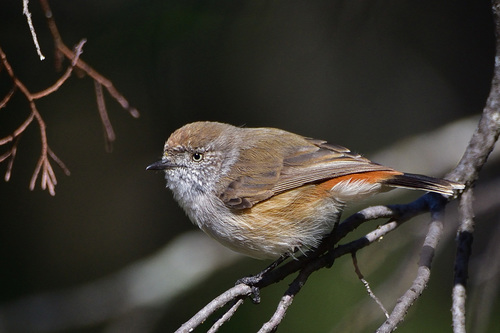
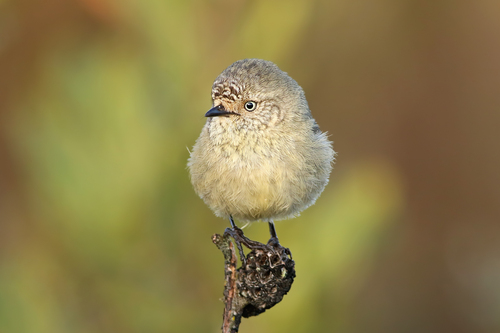
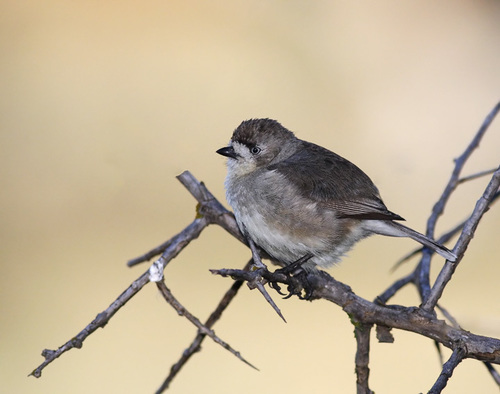
The southern whiteface (Aphelocephala leucopsis) is a stocky, thornbill-like bird. It has a brown back, white belly, dark brown wings, and a black tail with a narrow white tip. Some individuals have a light grey tint on the belly, and may also have a grey or rufous tinge on their flanks. Like all species in its genus, it has characteristic facial markings: a white band across the forehead, with a darker streak running along its top edge. Adult southern whitefaces are around 11.5 cm (4.5 in) long, with cream-colored eyes, grey legs, and a stubby dark grey finch-like bill. Adults of this species are sexually monomorphic, while juveniles can be told apart by the absence of the black rear facial band. The species’ call is a rapid, noisy twittering sequence transcribed as tchip-tchip-chiptchipt-chipt-chip or tzip-tzip-tziptzip; when alarmed, it produces a harsher call transcribed as kzzurrk, kzzurrk-kzzurrk. It can be told apart from other whiteface species by its duller overall appearance and the absence of a breast band, which is present on both the banded whiteface and chestnut-breasted whiteface. The southern whiteface is a polytypic species with two currently recognized subspecies. The nominate subspecies A. l. leucopsis occurs across south-eastern and central Australia. This subspecies varies in how much grey color appears on its flanks, with individuals becoming progressively paler in populations found further to the northwest. The paler form of this subspecies was previously classified as a separate race called whitei. The second subspecies, A. l. castaneiventris, is found in south Western Australia, and can be recognized by the distinct rufous wash on its flanks. The southern whiteface is endemic to Australia. It typically inhabits arid open woodlands with a shrubby or grassy understory, as well as grasslands across most of southern Australia. It is not found in Tasmania or on mainland Australian coastal areas. It favors Acacia woodlands, especially those dominated by mulga, plus drought-resistant chenopod shrubs including saltbush and bluebush. The species is generally considered sedentary, but atlas records show that individual birds may move into wetter areas outside their usual normal range during drought years.