About Aphareus furca (Lacepède, 1801)
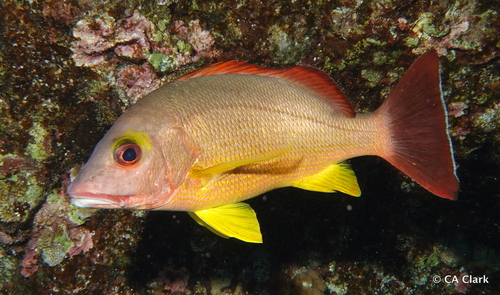
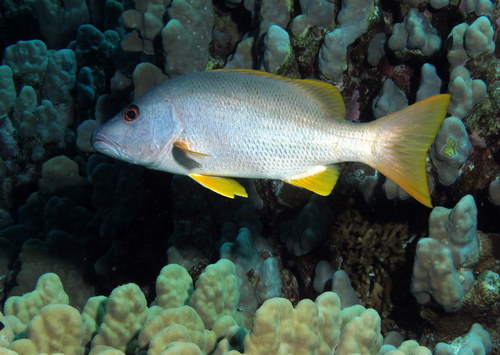
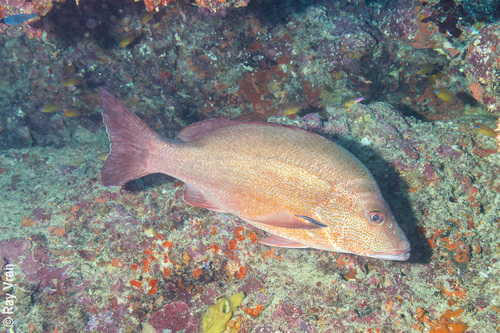
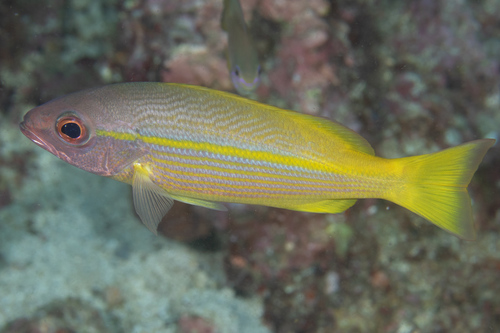
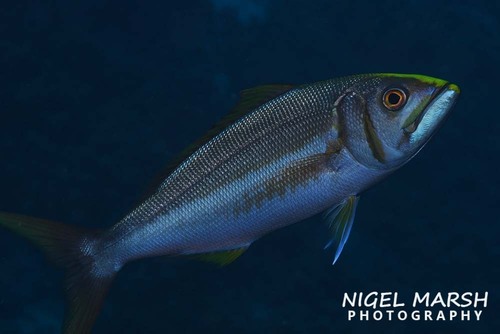
Aphareus furca (Lacepède, 1801) is a member of Lutjanidae, the family of tropical snappers and sea perches. Adults can be reliably identified by their specific coloration. This species has long filaments at the tips of its tail fin. Its body is bronze to blue-gray in color, and its fins are yellow; males can additionally be identified by yellow coloration on their head. This fish reaches a maximum total length of 70 cm, but most individuals commonly grow to 25 cm long. Fin ray counts for this species are as follows: the dorsal fin has 10 spines and 10 or 11 soft rays (most often 11), the anal fin has 3 spines and 8 soft rays, and the pectoral fins have 15 to 16 rays.
Aphareus furca is distributed across the Indo-Pacific, ranging from Hawaii south to the Pitcairn Islands, and spanning West and East Africa. Its range also extends from the Gulf of Mannar north to southern Japan, and south from Japan to Australia. It has been collected at depths between 1 and 122 m, with rare records of individuals found as deep as 302 m. In the late 1990s, this species was present at 38.6% of surveyed sampling sites, and made up 2.5% of total recorded fish biomass in those surveys. Between 2008 and 2014, population density estimates for Pacific coral reef habitats ranged from 2.5 to 41.2 individuals per hectare. The species' population size is impacted by fishing: population sizes increase in areas where fishing pressure is reduced. The highest recorded population densities were 19.4 individuals per hectare in the Line Islands, and 63 individuals per hectare in the Phoenix Islands. Lower densities, ranging from 0.3 to 17.2 individuals per hectare, were recorded in the Federated States of Micronesia, the Solomon Islands, the remote islands surrounding the Solomon Islands, Fiji, and Raja Ampat.
Aphareus furca is a benthopelagic and pelagic species that most often inhabits inshore coral and rocky reef areas, rocky bottoms, and clear water lagoons. This species is piscivorous, meaning it feeds on fish, and can be found alone or in small groups. It typically occurs at depths of 1 to 120 m, though it has been reported as deep as 300 m.