About Aparasphenodon brunoi Miranda-Ribeiro, 1920
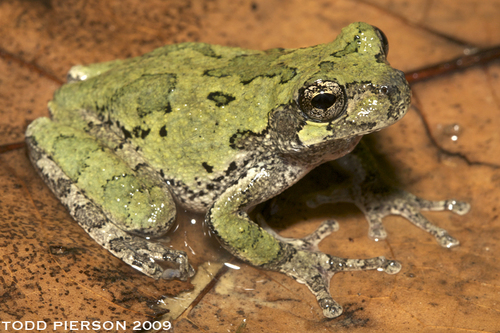
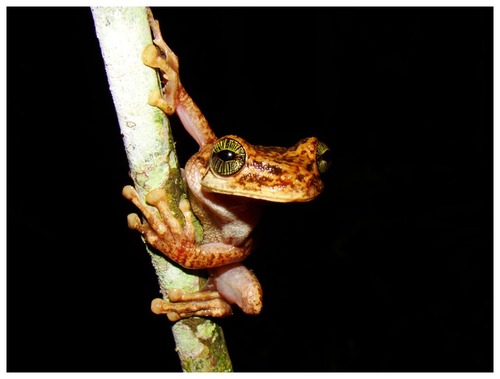
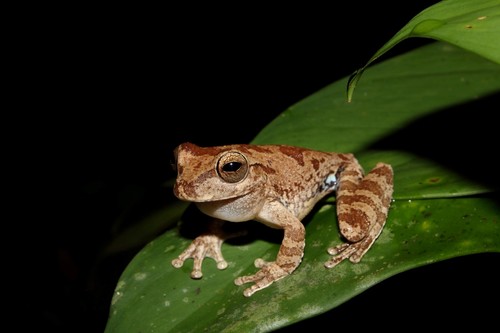
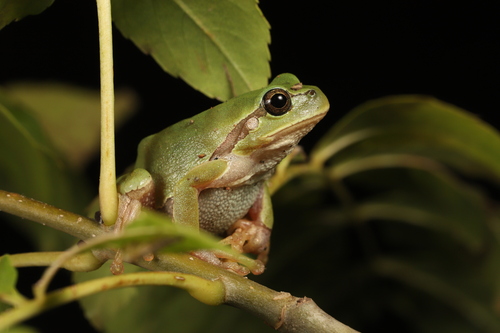
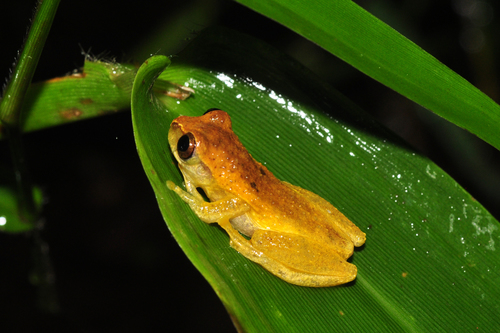
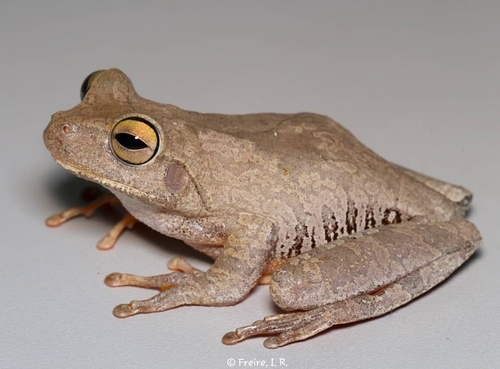
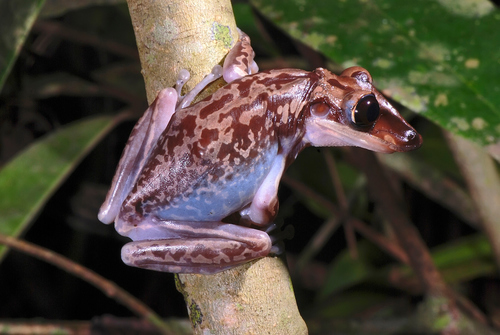
Aparasphenodon brunoi, commonly known as Bruno's casque-headed frog, is a relatively large frog species. Males have a snout-to-vent length between 4.9 and 6.2 cm (1.9 to 2.4 in), while females are larger, ranging from 5.6 to 8.1 cm (2.2 to 3.2 in). This frog has a broad, flattened head with a long pointed snout, and its prominent eyes face forward. It has an array of sharp, pointed projections on its head, and the skin of the head is fused to the skull. Its legs are long and slender, and its digits have adhesive discs at their tips. The dorsal surface of the species is pale brown or gray, marked with irregular dark patches. Bruno's casque-headed frog is endemic to the coastal region of southeastern Brazil, east of the Brazilian Highlands. Its range extends south from the state of Bahia to the northern part of the state of São Paulo, and it occurs at altitudes up to approximately 500 m (1,600 ft). It inhabits forests and forest edges. During the day, it hides in water-filled hollows in trees or bamboos, as well as in water-filled bromeliad rosettes. It selects hiding crevices that are exactly its size, and uses its head to seal the crevice entrance. Unlike poison dart frogs, which only secrete poison through their skin, this species has skull spines that can inject venom into other animals or human hands through headbutting, a defensive trait it shares with Corythomantis greeningi. The venom of A. brunoi is estimated to be 25 times as toxic as the venom of local fer-de-lance pit vipers, with an LD50 of 0.16 mg/kg when administered intraperitoneally (I.P) and 1.6 mg/kg when administered subcutaneously (S.C).