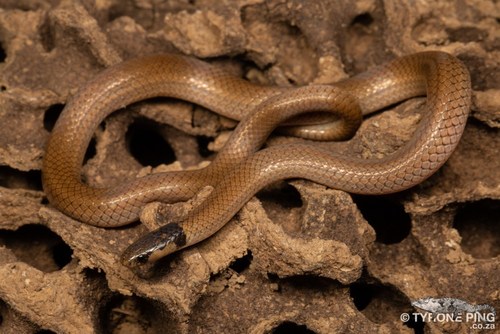
About Aparallactus capensis Smith, 1849
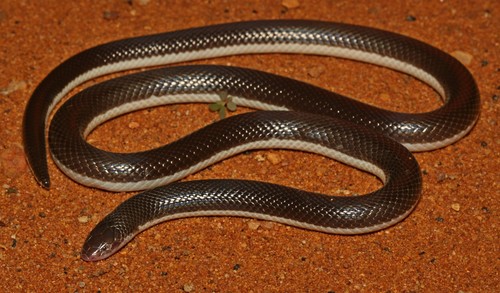
This species, Aparallactus capensis Smith, 1849, has a yellow or pale reddish-brown dorsal surface, which may or may not have a dark vertebral stripe. Its ventral surface is yellowish white. The neck and top of the head are black, and there may or may not be a yellowish crossbar behind the parietal scales. The sides of the head are yellowish, while the scales that border the eye are black. Fully grown individuals can reach a total length of 33.5 cm (13 1/4 inches), with a tail measuring 7 cm (2 3/4 inches) long.
When viewed from above, one-third of the rostral scale is visible, and this visible portion is 1/3 as long as the distance between the rostral and the frontal scale. The frontal scale is 1 1/2 to 1 2/3 times longer than it is broad, much longer than the distance from the frontal to the tip of the snout, and slightly shorter than the parietal scales. The nasal scale is intact, and touches the preocular scale. There is one postocular scale. There are seven upper labial scales; the third and fourth labials reach the eye, and the fifth labial touches the parietal scale. The mental scale touches the anterior chin shields, which are equal in length to or slightly longer than the posterior chin shields. The anterior chin shields touch three lower labial scales. The smooth dorsal scales are arranged in 15 rows. There are 138 to 166 ventral scales; the anal plate is intact; there are 37 to 53 entire subcaudal scales.
This species feeds exclusively on centipedes. It is oviparous, or egg-laying, and lays between 2 and 4 eggs during the summer. Aparallactus capensis is preyed on by other snakes (including garter snakes and stiletto snakes), spiders, scorpions, and very rarely by centipedes. It is found in South Africa, Eswatini, Zambia, Botswana, Zimbabwe, Mozambique, and the Democratic Republic of the Congo.