About Apantesis phalerata Harris, 1841
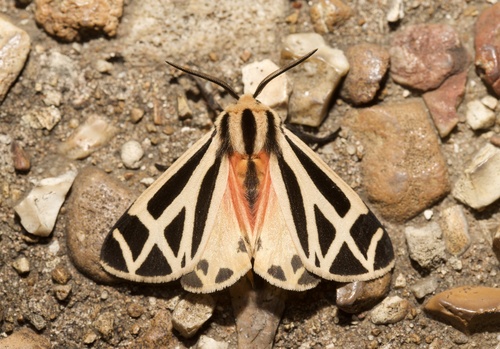
Apantesis phalerata, commonly called the harnessed tiger moth, belongs to the subfamily Arctiinae, a group of around 11,000 global tiger moth species split into three tribes. Like other tiger moths, this species has tymbals on its metathorax that it uses to produce high-frequency clicks. These clicks act as a defense against predators and are also used for communication during mating. Harnessed tiger moths are native to North America. Their range extends from Ontario, Quebec, and Maine in the north, south to Florida, Texas, and South Dakota. The flight period of adult A. phalerata differs by region: it runs from April to September in the southern parts of its range, and from May to August in northern areas. A. phalerata goes through complete metamorphosis over its life cycle, with four distinct stages: egg, larva (caterpillar), pupa, and adult. Caterpillar harnessed tiger moths feed on a wide range of vegetation, including grasses, garden crops, and low-growing plants such as Trifolium (clover), Spartina (cordgrass), Taraxacum (dandelion), and Plantago (plantain). The species' cocoon is constructed mainly from hairs shed by the larva. Adult A. phalerata have a wingspan between 30 and 42 mm (1.2 to 1.7 inches). They are recognizable by their distinctive black and orange wing patterns, which is the reason they are called "tiger" moths. This bright coloration is a form of aposematism, a defensive strategy that warns predators the moths are unpalatable. Even with these warning colors, harnessed tiger moths are preyed on by bats, which hunt using echolocation. Their vibrant coloration works as a visual deterrent, letting potential predators know they are distasteful. After mating, adult harnessed tiger moths live between 5 and 10 days. Their lifespan and mortality rates are affected by multiple factors, including the act of mating and available dietary conditions.