About Apamea monoglypha (Hufnagel, 1766)
Scientific name: Apamea monoglypha (Hufnagel, 1766)
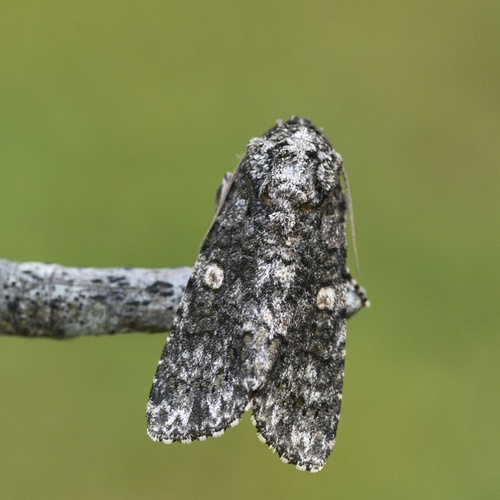
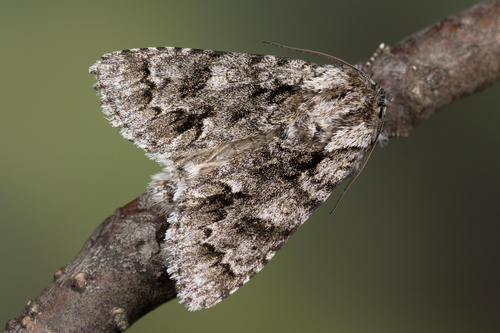
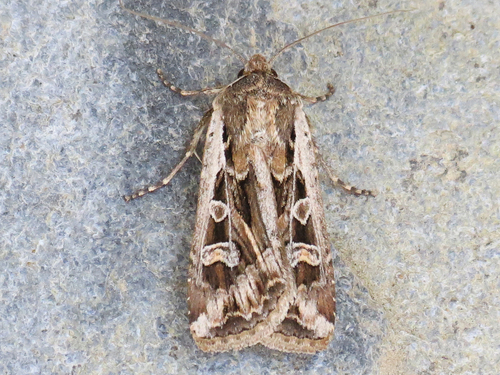
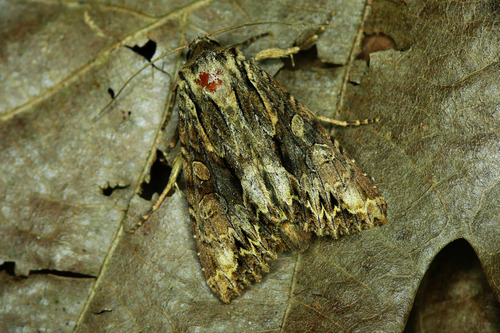
Technical description and variation: The forewing ranges in color from whitish ochreous, through pale and dark grey, to brownish grey, dark brown, and black. There is a black streak from the base below the cell, a second black streak above the inner margin near the base, and a third, more strongly marked black streak along the submedian fold between the claviform stigma and the outer line. The inner and outer lines are pale, with dark edges. The claviform stigma is small and dark-edged. The upper stigmata are large, matching the ground color or paler, with pale rings and dark outlines. The orbicular stigma varies in shape, generally being oblique and elongate, sometimes shortened, and more rarely rounded. The submarginal line is pale and zigzag, preceded by black wedge-shaped marks; the terminal area is darker, except at the apex. The inner margin is usually marked with white scales, which develop beyond the outer line into a more or less prominent pale patch that reaches the submedian fold. The hindwing is dirty greyish, with darker cell spot and veins, and has a broad fuscous marginal border preceded by a dark outer line.
The aberration pallida Fuchs is wholly whitish ochreous, with all black streaks clearly visible and stigmata black-edged; the central and terminal areas are washed with brownish grey, and the hindwing is whitish with a faintly marked ochreous grey border. In the form intacta Petersen, the usual pale patch beyond the outer line on the inner margin is absent, and the whole forewing is suffused with grey or grey brown. The aberration obscura Th. Mieg. is a suffused brown or grey-brown form. The form infuscata Buch. White is a northern form where markings are more or less obscured and hidden by blackish suffusion; brunnea Tutt is a brown-black offshoot of this form. The extreme form of infuscata, where all markings are lost in intense black suffusion, is aethiops Tutt. In all of these dark-suffused forms, the hindwing is much darker, especially in the terminal area.
This moth flies at night. In the British Isles, it is active from June to August, and a second brood sometimes emerges in September and October. It is attracted to light, sugar, and many nectar-rich flowers. The larva feeds on the roots of various grasses, including tussock grasses, orchard grass, ryegrass, reed grasses, and fescues such as sheep's fescue. This species overwinters in the larval stage.