About Apamea lateritia (Hufnagel, 1766)
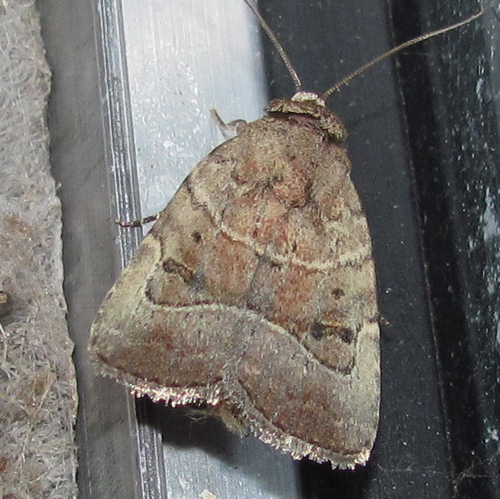
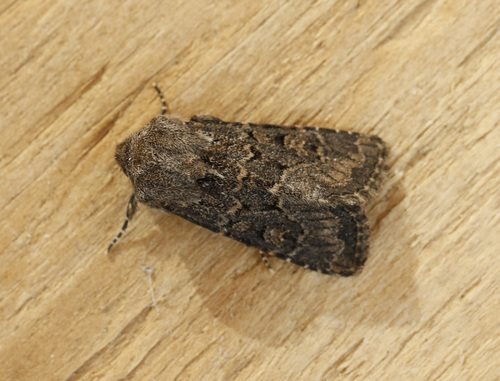
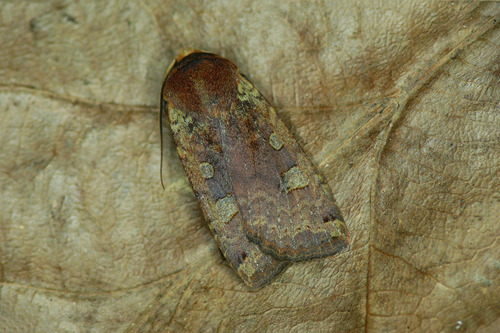
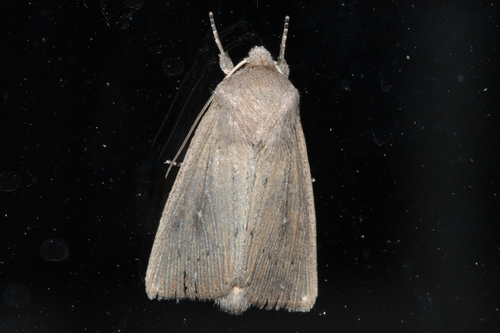
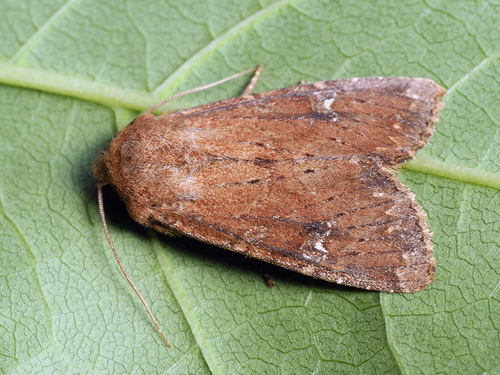
Scientific name: Apamea lateritia (Hufnagel, 1766). Technical description and variation: A. lateritia Hufn. (= molochina Hbn.) (39 i). Forewings are dull purplish red-brown, darker toward the costa; the costal area and veins are sprinkled with white scales. The inner and outer lines are double, lunulate-dentate, with their teeth marked dark and light on the veins. The claviform stigma is absent; the orbicular and reniform are dark red brown with incomplete white annuli, and the orbicular is generally obscure and lacks a white outline. The submarginal line is indistinct; the terminal area, except at the apex, is rather darker. The hindwing is fuscous, greyer toward the base, with a dark cell spot and dark veins. Ab. borealis Strand, from Lapland, is an even darker brown. Ab. derufata ab. nov. (39 i) is pale purplish red, with no dark red-brown tinge. The form expallescens Stgr. (39 i), from Turkestan and Tibet, is pale reddish ochreous, flushed with brown or grey brown, and its terminal area is always dark brown. Ab. festiva ab. nov. (40 a), from Transcaucasia, is rather smaller than expallescens, and is pale brickred with somewhat rough scaling. Lastly, ab. sordida ab. nov. (40 a), a decidedly smaller form, is dirty brownish fuscous, with well-marked inner and outer lines that are approximated on the inner margin. A fairly long series of this form, all males, is held in the Tring Museum, collected from Pescocostanzo, Italy. The larva is dull dark grey, with a brown head, and black thoracic and anal plates. The wingspan of this species is about 42–50 mm.