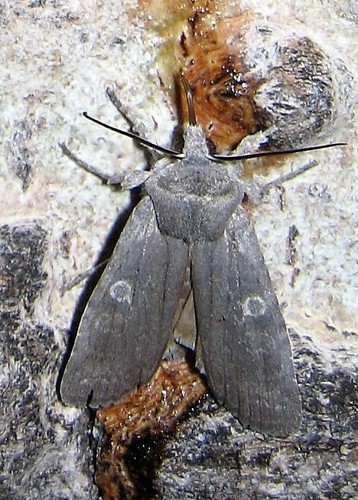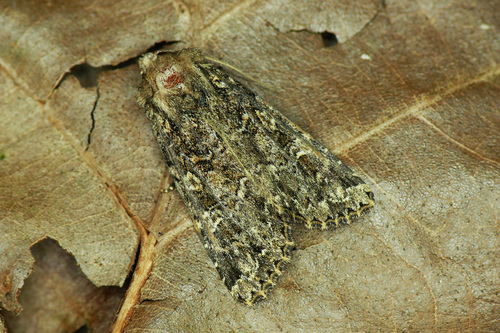
About Apamea furva (Denis & Schiffermüller), 1775
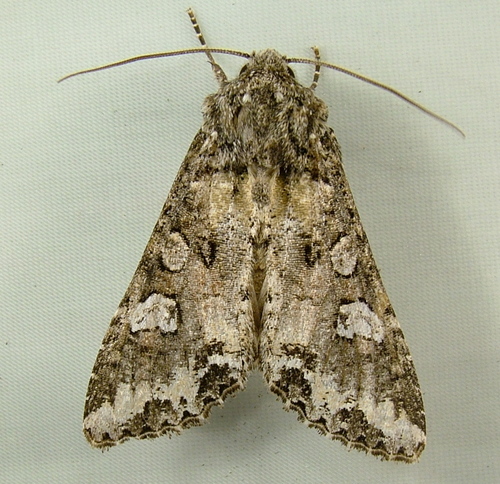
Apamea furva, commonly known as the confused, is a moth species belonging to the Noctuidae family. The species was first formally described by Michael Denis and Ignaz Schiffermüller in 1775. This moth is distributed across the whole of Europe. In southwestern Europe, it occurs mainly in mountainous regions. Its range extends north to the Arctic Circle. Outside of Europe, its distribution stretches to Siberia, Turkey, Iran, Kyrgyzstan, Mongolia, and Xinjiang, China. Populations in Great Britain and Ireland are sometimes classified as a separate subspecies, Apamea furva britannica. The wingspan of this moth measures 34 to 42 mm. The forewing varies in color from brownish to blackish fuscous, with more or less grey or whitish scale dusting; this dusting is most prominent along the costa, inner margin, and veins. The forewing lines are edged with pale colour. The claviform stigma is either edged with black, or entirely filled in with black. The orbicular stigma is grey, with a pale ring and black outline, and is often indistinct. The reniform stigma is always whiter, particularly on its outer edge. The submarginal line is whitish and wavy, and is always preceded by distinct black wedge-shaped marks. The brown forewing fringe is divided by fine pale dashes. The hindwing is smoky grey, with the terminal half being smoky fuscous; the veins and cellspot are darker than surrounding areas. Blackish fuscous specimens that retain paler dusting are classified as two aberrations: ab. freyeri [Boie] and infernalis Ev., with infernalis Ev. being the darker form of the two. Apamea furva is hard to reliably distinguish from its related congener Apamea remissa (Hübner, 1809); see Townsend et al. for more details. Adult moths are active and in flight from July to August. The larvae feed on the roots and stem bases of various grasses, including meadowgrasses, fescues, slimstem reedgrass, and wavy hairgrass.