About Apamea crenata (Hufnagel, 1766)
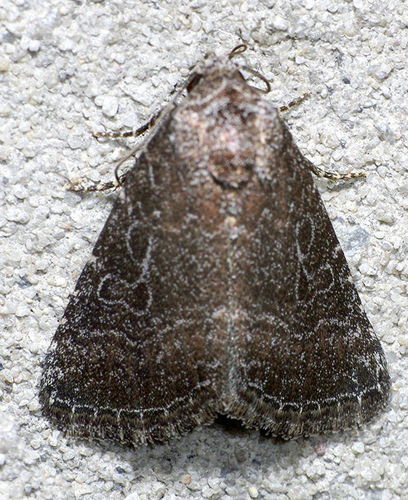
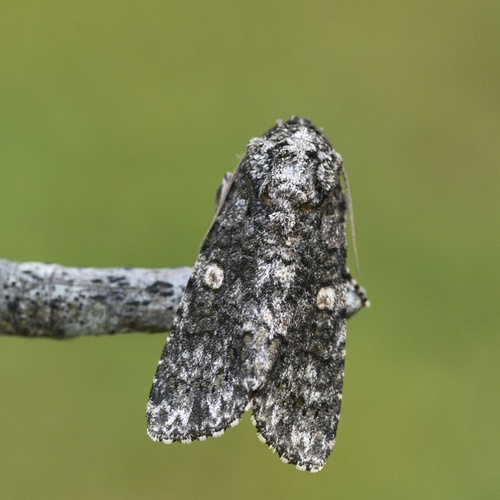
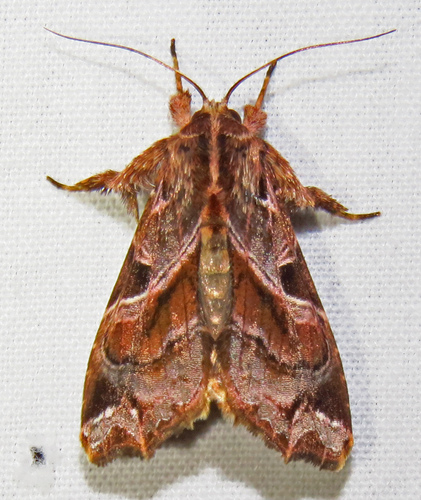
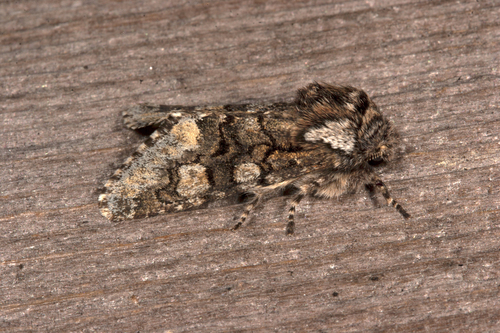
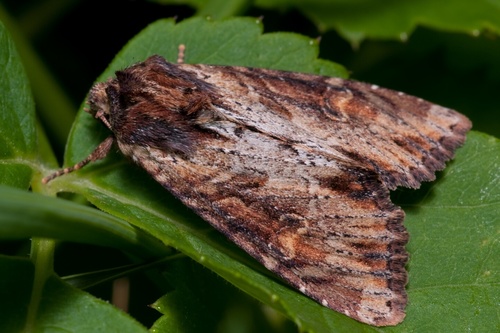
This species, Apamea crenata, has a wingspan ranging from 36 to 44 mm. Its forewings are pale brown with darker patches along the margins, and they typically feature prominent markings at the base and tornus. The hindwings are grayish with darker venation, and melanic forms occur fairly frequently. For technical details and variation: The forewing is pale lilac grey, often washed with pale brownish; the veins are paler, the costal area is tinged with purplish grey, and the inner margin is white with a strong black streak near the base. The inner and outer lines are double and brownish; the outer line is followed by a double row of dark brown vein dots with a white dot between them. The claviform stigma is brown with a darker outline. The orbicular stigma is generally elongate and narrow, sometimes shortened and rounder, with a brown centre matching the reniform stigma and a pale outline. The outer half of the reniform stigma is paler than the inner half, and its lower lobe is dark. The cell and median shade are brown, and the median shade does not extend below the cell. The marginal area beyond the submarginal line is dark red-brown, and projects large inward-pointing teeth on the two folds. The hindwing is fuscous, and pale grey toward the base. The aberration argentea Tutt is a form from Scotland where the forewing ground colour is shining silvery whitish, with only faint traces of pale brownish costal streaks; the terminal area and basal streaks are pale brown, all other markings are obsolete except for a faint trace of the reniform stigma, and the hindwing is pale grey. Forma ochrea Tutt and intermedia Tutt only represent the type form washed with pale ochreous, or with rufous ochreous respectively, and intermedia Tutt is the commonest form in Britain. Forma flavorufa Tutt is a rare form found only in northern England and Scotland. It has a dull yellow-red ground colour, with all ordinary markings obsolete except the stigmata, which are distinct and outlined with yellow. It also has some short yellow costal dashes, a yellow patch at the base of the costa, and yellow scales on the dark veins. The form putris Hbn. has the entire forewing suffused with dull grey brown, with the median area between the inner and outer lines darker brown from costa to inner margin; the white scales of the inner margin are more distinct. Some examples are more uniformly dark with obscured markings, while others are paler brown with clearly visible markings. Forma combusta Haw. is a dark fuscous form of putris Hbn., in which the basal area and both lines are mixed with white scales, and the outer edge of the reniform stigma is also whitish. Aberration alopecurus Esp. is red-brown with dark veins; the costa, inner margin, and sometimes the veins are dusted with whitish, and the stigmata are edged with yellow. The two folds are redder than the rest of the wing. In some cases this red tint dominates, turning the entire wing red; in others blackish shades overpower the red, and these darker specimens are classified as nigrorubida Tutt. Aberration subrurea Petersen is a form with the forewing darkened by grey brown, with clear markings, and the reniform stigma is not outlined in yellow. Extincta Stgr., found in Issykkul and Kuku Nor, has a uniform pale lilac grey forewing; the terminal area and the cell are dull redbrown, the lines are very indistinct, the stigmata are pale grey, the outer edge of the reniform stigma is whitish, and this pale form has a matching dark form, parallel to how alopecurus matches the typical rurea. Aberration uniformis ab. nov. [Warren] is entirely dull dark liver colour, with no markings other than the pale inner and outer lines and the whitish outer edge of the reniform stigma, and the hindwing is smooth pale grey, just like in extincta.