About Apalone spinifera (Lesueur, 1827)
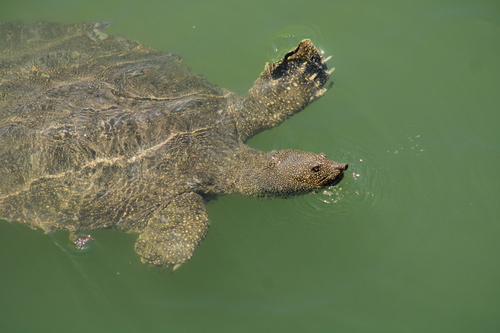
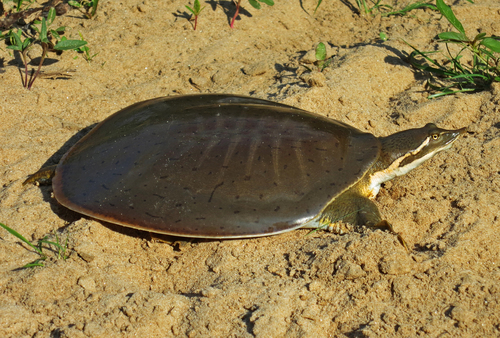
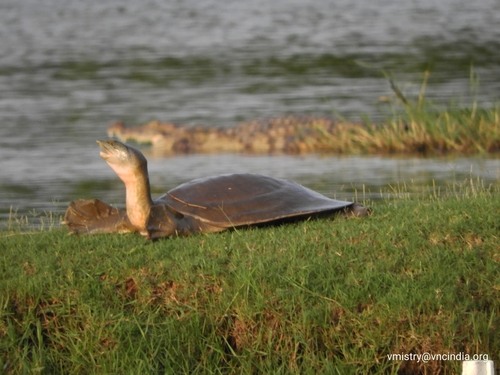
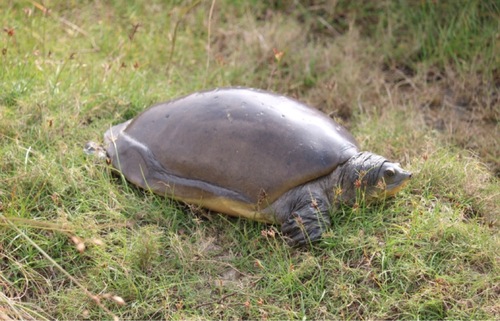
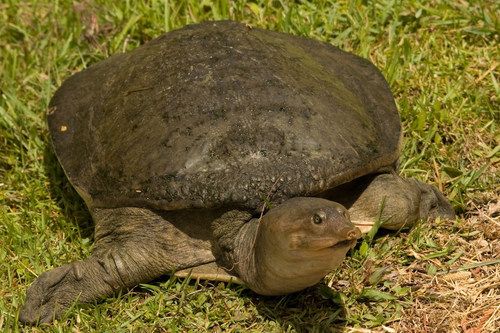
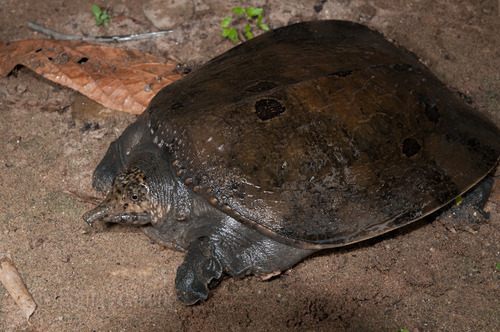
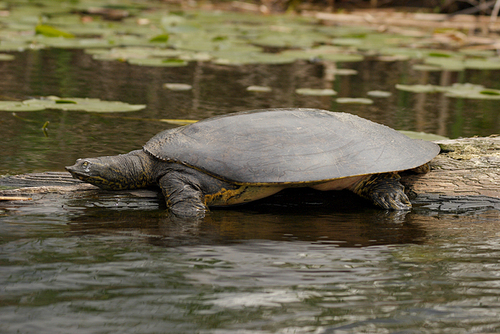
The scientific name of the spiny softshell turtle, Apalone spinifera, is highly descriptive of the species. The genus name Apalone derives from the Greek word apalos, which means soft or tender; the species epithet spinifera comes from Latin, where spina- refers to a thorn or spine and -ifer means bearing. This species belongs to the Trionychidae turtle family. One of the most distinctive traits of all family members is a leathery, moderately flexible upper shell (carapace), which forms due to the loss of keratinized scutes and some bony tissue. Spiny softshell turtles have webbed feet, with three claws on each foot. Another defining trait of softshell turtles is a fleshy, elongated nose. The carapace ranges in color from brown or yellow-brown to olive, while the lower shell (plastron) is a lighter color, usually white or yellow. Hatchlings typically have dark spots on their carapace. As females age, their carapace often darkens or develops a splotched pattern, while males tend to retain the same color pattern they had at birth. Coloration also varies between subspecies, and individual coloration can depend on the turtle's local environment. Spiny softshell turtles have cryptic coloration, meaning their color pattern helps them blend into their surrounding habitat. They also have pale lines bordered by black lines that run from the head down the side of the neck. Adult carapace length ranges from 18 to 54 cm (7.1–21.3 in), and females grow larger than males. The species' namesake spines, also called tubercles, are found along the front edge of the carapace, and are more common in males. This variation in coloration, size, and spine presence means the species exhibits sexual dimorphism. A. spinifera has ridges on its nasal septum that give its nostrils a C-shape, which differentiates it from the similar species A. mutica, which has round nostrils. The spiny softshell turtle is the most widely distributed softshell turtle in North America, a range that may be expanded by human-caused habitat fragmentation. Its natural range covers most of the United States, extends north into the Canadian provinces of Ontario and Quebec, and reaches south into the Mexican states of Tamaulipas, Nuevo León, Coahuila, and Chihuahua. With human assistance, the species has recently expanded its range into New Jersey, Massachusetts, New Hampshire, Washington, and California, and has also been newly discovered in Lake Champlain, where it was not recorded historically. Spiny softshell turtles are considered ecological generalists, meaning they occupy a wide variety of habitats. They live in freshwater bodies including ponds, lakes, rivers, tributaries, bayous, oxbows, and streams. They can survive in more urban environments because they are well adapted to periodic habitat disturbance. They most often inhabit shallow water less than 1 m (3 ft 3 in) deep, but can also be found in water up to 10 m (33 ft) deep. One study found that when swimming, spiny softshell turtles get most of their propulsive power from their forelimbs, unlike most other turtle species that rely on hindlimbs for thrust. They can be found in areas with many different levels of vegetation, and while they are generally found in slower-moving waters, their greatest abundance occurs in waters with higher water clarity and slower water velocity. Spiny softshells prefer waters with sandy bottoms and clean, sandy banks. Sandy environments are important for their nesting sites, proper juvenile growth and development, and camouflage. Spiny softshell turtles migrate between seasonal zones for warm and cold seasons. They generally stay within a single zone during each season, and move more frequently within their zone during warm months. Their average home range length across seasonal migrations is 10.8 km (6.7 mi). A study of home range behavior in the eastern spiny subspecies — which has the largest and most northerly distribution of the subspecies — found that turtles in northern Lake Champlain typically have two annual concentration areas, one for spring-summer and one for fall-winter, which contributes to their large overall home range. The same study found that the mean annual home range of females is over 10 times larger than that of males. The study suggested that this large home range is caused by habitat fragmentation. Spiny softshell turtles reach sexual maturity and begin mating between 8 and 10 years of age. Large female spiny softshell turtles can live up to 50 years. Mating occurs in mid-to-late spring in deep water. During courtship, the male swims alongside the female, nudges her head, and waves his feet in front of her face. If the female accepts the male, he swims above her without clasping her with his claws, a behavior that differs from that of most other turtle species. Before nesting, females follow a three-stage daily activity pattern: they start the day basking and moving within a small area, spend most of the afternoon swimming to a new area, and finally stop to search for a suitable nesting site. A few months after mating, the female quickly lays her eggs in a flask-shaped cavity she digs near the water, along a sunny sandbar or gravel bank. Nesting activity typically begins around July, when females leave the water and probe the ground with their snout to find a suitable nesting spot. Females nest more than once in a single breeding season, and can lay between 9 and 38 round, calcareous-shelled eggs per clutch. Egg laying takes place between July and September, and eggs hatch the following spring. Larger females have been recorded laying a second clutch in late June or July. Studies of nesting behavior have found that females are more likely to lay eggs on days with a small difference between air and water temperature. Unlike many other turtle species, the sex of spiny softshell turtle hatchlings is not determined by incubation temperature; it is determined by genetics. Researchers have recently discovered that late-term embryos and hatchlings make various click and chirp-type sounds before they emerge from the nest onto the surface. The function of these sounds is currently unknown.