About Apaloderma vittatum Shelley, 1882
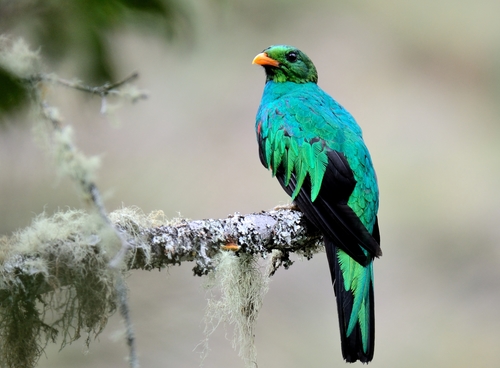
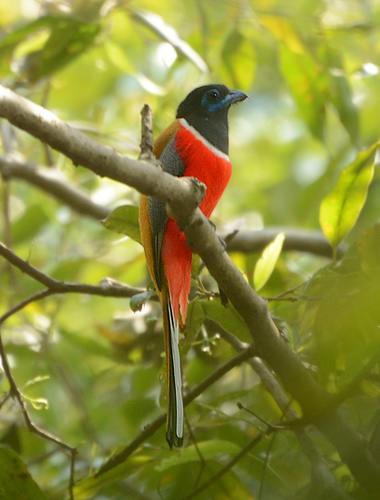
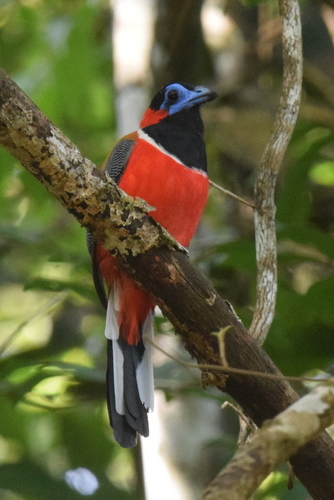
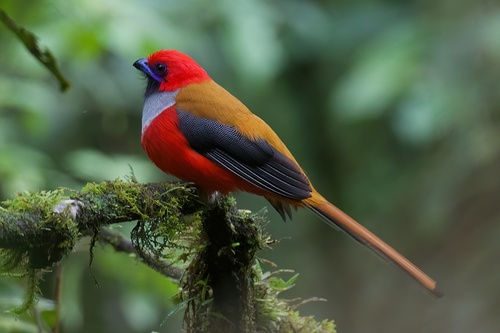
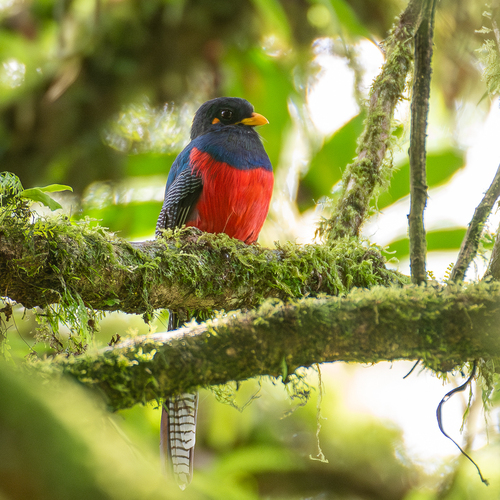
The bar-tailed trogon (Apaloderma vittatum Shelley, 1882) averages about 28 centimetres (11 in) long. Its bill and feet are yellow, and its tail, which is long and broad like most trogons, has narrow black and white barring on the underside. Males have a blue-black head with bronze iridescence. Below the eye, there are two patches of bare yellow or orange skin, while a yellow or grey bare skin patch sits above the eye. The male's upper breast is iridescent, ranging in color from violet to blue-green, and the rest of its underparts are red. The male's back is green, and the upper surface of its tail is blue-black or purple-black. Females have a brown head and less ornamental bare skin, with light cinnamon throat and breast; otherwise females resemble males. Immature bar-tailed trogons are similar to females, but have a white belly and pale spots on the wings formed by the tips of the wing coverts and inner secondaries. The species' vocalizations are described as a yelping crescendo, sounding like "yaow, yow, yow, yow… or wuk-wuk-wuk-wuk…". Females produce a whining "chee-uu" call. The bar-tailed trogon occurs in Angola, Burundi, Cameroon, the Congo, Equatorial Guinea, Kenya, Malawi, Mozambique, Nigeria, Rwanda, Tanzania, Uganda, and Zambia. It inhabits forests at altitudes between 900 and 3,000 m (3,000 and 9,800 ft), which is typically higher than the altitude range of the Narina trogon, though the two species occur together in some locations.