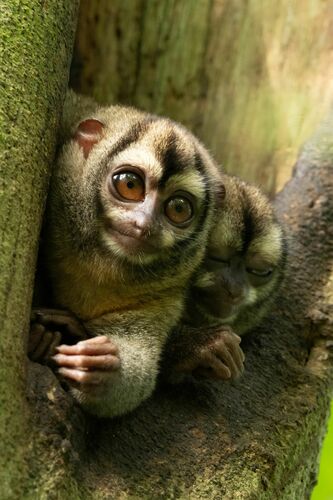
About Aotus zonalis Goldman, 1914
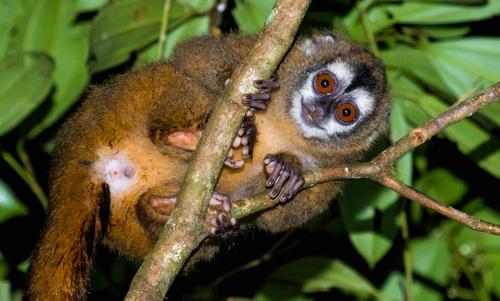
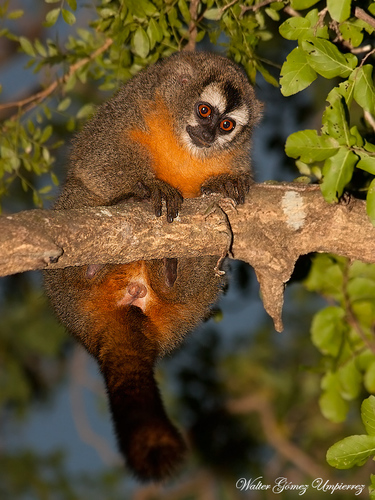
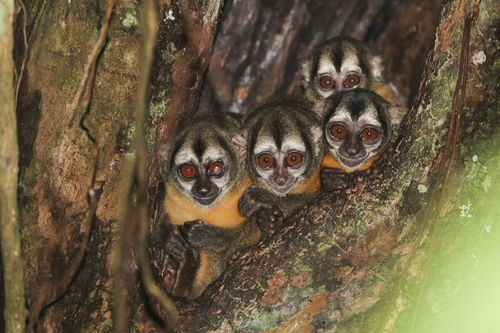
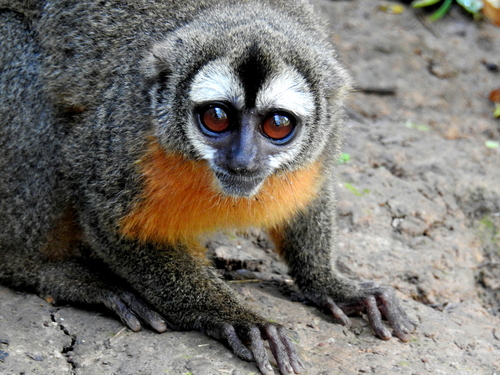
The Panamanian night monkey, also called the Chocoan night monkey (Aotus zonalis), is a night monkey species in the family Aotidae that was formerly classified as a subspecies of the gray-bellied night monkey. Its confirmed range covers Panama and the Chocó region of Colombia. There are unconfirmed reports that it also lives in Costa Rica, particularly along the country's Caribbean coast. The species is confirmed to live in Panama's Atlantic lowlands, close to the Costa Rica border. The exact classification of the Panamanian night monkey remains uncertain. Some authors still classify it as a subspecies of the gray-bellied night monkey, A. lemurinus, while others follow a 2001 study by Thomas Defler which concluded it is a separate species, A. zonalis. It is a relatively small monkey, with males weighing approximately 889 grams (31.4 oz) and females weighing approximately 916 grams (32.3 oz). Its back fur ranges from grayish brown to reddish brown, while its belly is yellow. The hair on the back of its hands and feet is black or dark brown, which is a key distinguishing feature from other northern "gray-necked" Aotus species; it also has shorter fur than these relatives. Other distinguishing features relate to its skull, which has a broad braincase, a depressed interorbital region, and large molariform teeth. Like other night monkeys, the Panamanian night monkey has large eyes suited to its nocturnal lifestyle, but unlike many other nocturnal animals, its eyes do not have a tapetum lucidum. Also like other night monkeys, it has a short tail relative to its body size. The Panamanian night monkey is arboreal and nocturnal. It, along with all other members of the genus Aotus, makes up the only nocturnal group of monkeys. It can be found in several types of forest, including secondary forest and coffee plantations. It lives in small groups of between two and six monkeys, made up of an adult pair, one infant, and several juveniles and/or subadults. Groups are territorial, and their home ranges only overlap slightly. Vocal, olfactory, and behavioral communication methods have all been recorded in this species. At least nine distinct vocal calls have been reported, including different types of grunts, screams, squeals, moans, and trills. Males develop a scent gland near their tail at around one year of age, which is used for scent marking. Urine washing, a behavior where urine is rubbed onto the hands and feet, is also used for communication. Behavioral communication appears to be less important than vocal and olfactory communication, but specific behavioral displays have been observed, including arched back displays, stiff legged jumping, urination, defecation, and piloerection. The Panamanian night monkey generally walks on all four legs, though it can leap or run when needed. It eats a wide variety of foods. One study conducted on Barro Colorado Island in Panama found its diet was made up of 65% fruits, 30% leaves, and 5% insects. Like other night monkeys, the Panamanian night monkey is one of the few monkey species that is monogamous. Monogamous pairs usually give birth to a single infant each year, though twins are occasionally born. The gestation period is approximately 133 days. The father carries the infant starting when the infant is one or two days old, only passing it to the mother for nursing. While wildlife viewing that includes monkeys is popular with tourists visiting Panama, the Panamanian night monkey's nocturnal habits mean it is seen less often than other Panamanian monkey species. It is still possible to observe the species when accompanied by a skilled guide, however.