About Aotus lemurinus I.Geoffroy Saint-Hilaire, 1843
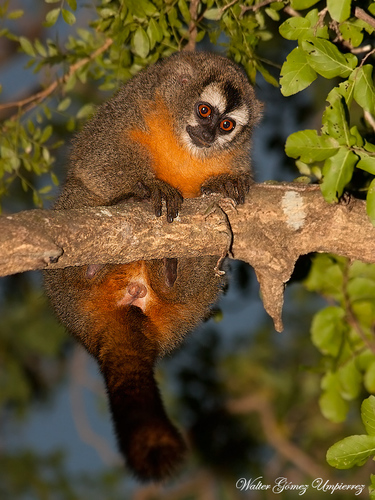
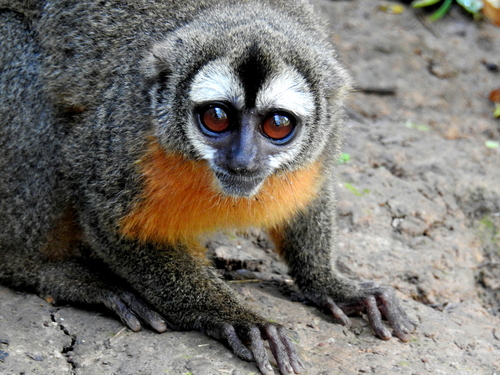
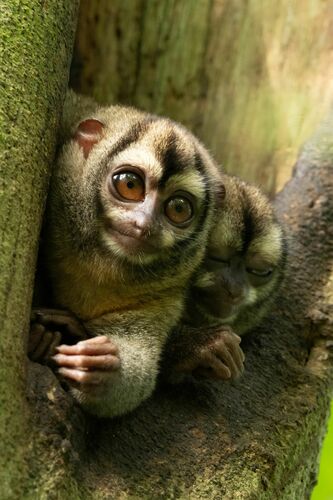
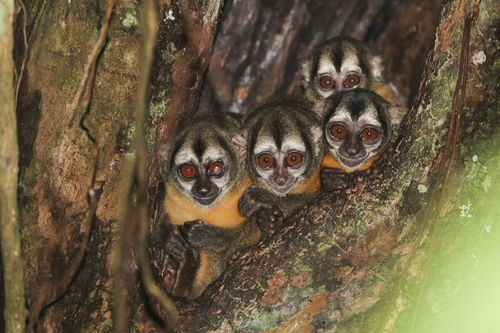
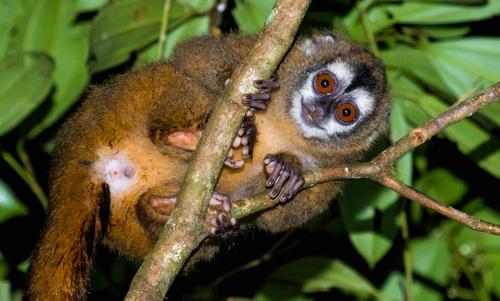
Like other members of its genus, Aotus lemurinus is a nocturnal species. It has a small, round head striped with black, dominated by two large brown eyes, giving it an appearance very similar to an owl. When light reflects off its eyes, they shine a reddish orange. It has bushy white eyebrows, with a patch of darker fur between them. Its overall grey fur is dense and woolly, while the underside of its body ranges from yellow to orange in colour. Its non-prehensile tail varies in colour from brownish black to orange, and is always tipped with black. This species, the gray-bellied night monkey, has slender limbs with long, delicate fingers and wide fingertip pads. Adult individuals can reach a weight of 1.3 kilograms, and no sexual dimorphism has been observed in this species. The gray-bellied night monkey occurs in both dry and moist habitats, and occupies all levels of the forest canopy. It is very rarely found on the ground, and prefers dense vegetation with tangled vines where trees are evenly dispersed. Its geographic range extends from Colombia to Venezuela, Ecuador, and Panama, and it is also found in the tropical Andes. During the day, this monkey sleeps in tree cavities or dense thickets. At night, it forages through the canopy for a variety of food items. It is primarily a frugivore, meaning it eats mostly fruit, but will also consume vegetation, insects, nectar, and even other small mammals and birds when fruit is not abundant. The gray-bellied night monkey is most active during twilight hours and periods of bright moonlight. Troops of this species consist of a mated pair and their offspring, with a maximum total of five individuals. This species is known for forming monogamous pair bonds, and parental duties are shared between the breeding pair and juveniles in the troop. However, the male carries out most caregiving and rearing work; the female only provides nursing for infants. Remarkably, even if the male dies, the female will not take over his parental responsibilities. This monkey is characteristically loud, and produces a wide range of calls. These range from soft clicks and low-pitched guttural rumblings to owl-like hoots, and high-pitched shrieks when it feels threatened. When it is not feeding, the gray-bellied night monkey is typically inactive. Like other species in its genus, it claims a relatively small territory of around 0.1 km². Scent is a key part of intraspecies communication for this monkey; it marks territories with brown, oily secretions from the base of its tail. Births peak at the end of the dry season and during the middle of the wet season. Average gestation length is 133 days, and gestation usually produces a single infant; twins are very rare. This species produces only one litter per year. Offspring reach sexual maturity between 2.5 and 3.5 years of age. Once mature, offspring disperse, leaving their natal troop to search for an unpaired mate.