About Aonyx capensis (Schinz, 1821)
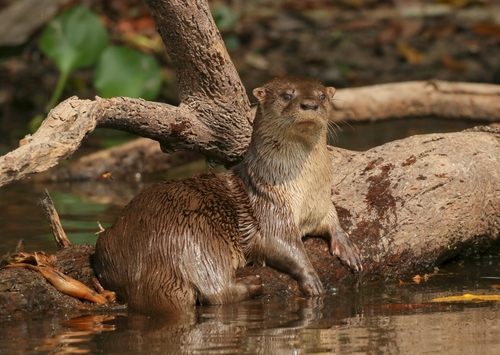
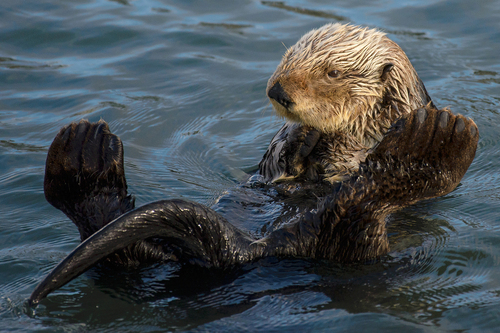
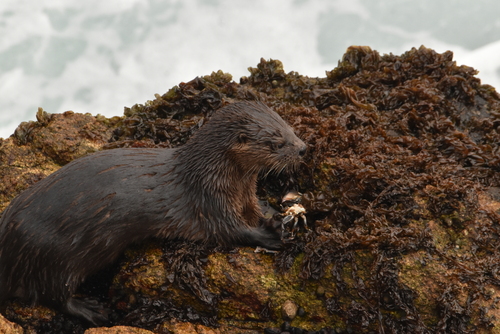
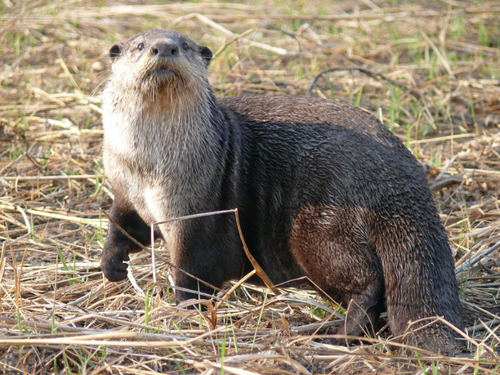
This species, the African clawless otter, has thick, smooth chestnut-colored fur, with an almost silky underbelly. A defining feature is its white facial markings, which extend downward to the throat and chest regions. Its paws are partially webbed with five digits, and it has no opposable thumbs. All digits lack claws except for the 2nd, 3rd, and 4th digits of the hind feet. This otter has a large, broad, flat skull, with a relatively small eye socket and a short snout. Its molars are large and flat, adapted for crushing prey. On average, male African clawless otters are slightly larger than females. Adult otters measure 113–163 cm (44–64 in) in total length, including the tail which makes up about one third of this length. Adult weights range from 10–36 kg (22–79 lb), with most individuals averaging between 12 and 21 kg (26 and 46 lb). On average, this is the third largest otter species, after the sea otter and giant otter. It is also likely the third largest extant mustelid, with a mean body mass that appears to slightly outrival that of wolverines, hog badgers, and European badgers. Despite being closely related to the Asian small-clawed otter, the African clawless otter is often twice as massive. African clawless otters inhabit a wide range of environments, from open coastal plains and semiarid regions to densely forested areas. They are found mostly across southern Africa, and live in areas surrounding permanent bodies of water, which are usually surrounded by some type of foliage. Logs, branches, and loose foliage are preferred by the species, as these provide shelter, shade, and suitable spots for rolling. African clawless otters move slowly and are rather clumsy on land. They build burrows in banks near water, which allows easier access to food and a quick escape from predators. In the False Bay area of the Cape Peninsula, these otters have been observed scavenging along beaches and rocks, and hunting mullet in shallow surf. In urban areas, they are mainly nocturnal, and rest during the day in quiet, bushy areas. African clawless otters spend most of their days swimming and catching food. A number of individuals were radio-tracked across boulders and reed beds, which provided the otters with shelter and let them catch more of their preferred prey: crabs. While they are mostly solitary, African clawless otters live in neighboring territories that can form family groups of up to five individuals. Each otter maintains its own individual range within the larger group territory, and they mostly stay alone unless seeking a mate. Otters mark their territories using a pair of anal glands that secrete a distinctive scent, and each otter is highly territorial over its personal range. They return to their burrows (called holts) for safety, cooling, or to rub down using grasses and leaves. As mainly aquatic creatures, they use their tails for locomotion to propel themselves through water. Their tails also help provide balance when the otters walk or sit upright. Mating occurs in short periods during the December rainy season. Females give birth to litters of two to five young in early spring. After mating, males and females go their separate ways and return to solitary lives, and young are raised entirely by females. Gestation lasts around two months (63 days). Weaning occurs between 45 and 60 days after birth, and young otters reach full maturity around one year of age.